


Left rectangle ads redesigned
Robert Ripps book
History of Tribeca Buildings
In the News: Everything that’s changed since congestion pricing

CONGESTION PRICING MAKES EVERYTHING BETTER
The Times has a celebratory piece on the effect of congestion pricing: “Fewer cars. Faster travel. Less honking. And some questions we still can’t answer.” There’s 2.3 million fewer cars for the month, or 12 percent fewer. Traffic speeds increased by 15 percent, especially at commuter times. Buses are moving faster, even in New Jersey. Traffic has not increased in the South Bronx. Mass transit ridership is up. Less people are complaining about noise. There are fewer traffic violations, mostly thanks to less risky driver behavior. Visitors are up in the congestion zone. More kids are getting to school on time. And congestion pricing is now more popular.
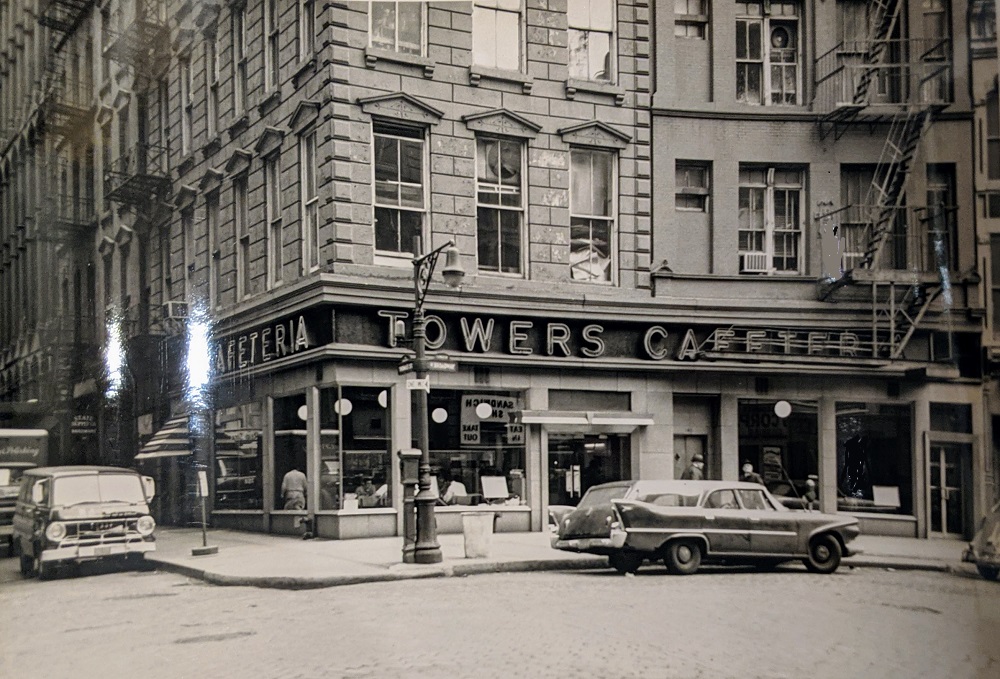
THE ODEON ORIGIN STORY
Keith McNally has a memoir in Grub Street that is a great read, starting with his job as a waiter at One Fifth, where he met his (now ex-) wife and Odeon owner Lynn Wagenknecht. The Tribeca part starts here: “Lynn and I decided to open our own restaurant. We were fed up slogging away for other people and were anyway bursting with restaurant ideas of our own. In the spring of 1980, we hit the streets looking for a space. The only area downtown we could afford was Tribeca, a neighborhood between Soho and the Twin Towers unknown to most people living above 14th Street. The real-estate broker gave us a list of three available spaces. The first two were lemons, but approaching the third, I noticed a red neon sign that shone so brightly it could be seen from Kansas. This was Towers Cafeteria. The second we pressed our faces against one of its three enormous windows, Lynn and I knew we’d struck oil.”
RAOUL’S ON FILM
Soho’s famed Raoul’s, the 50-year-old Soho French restaurant, has a documentary coming to the Tribeca Film Festival. From Eater: “Raoul’s, a New York Story” comes from next-generation owner, Karim Raoul, who teamed up with fellow writer director Greg Olliver. Over a decade in the making, the film — with tickets on sale now — will debut at this year’s Tribeca Festival, with theater times on June 10, 11, and 15.”
VORNADO IS READY TO BUILD APARTMENTS
Crain’s has an analysis of Vornado’s CEO Steven Roth’s interest in residential construction, and I link it here since the company owns 50 percent of Independence Plaza — though the story is largely about Penn Station. From Crain’s: “Vornado Realty Trust is ready to sell office towers and use the money to build apartments, a strategy shift likely to be cheered by those pushing for more housing around Penn Station. ‘People really want to live in New York. There is a major shortage of apartments in New York,’ CEO Steven Roth said in his annual letter to shareholders released late Tuesday. ‘So why aren’t we building some apartments? A very good question.'”
16 Comments
Comment:
Medium rectangle #1 (top)

Right column rectangle ads

Restaurant guide icon

Regarding Congestion Pricing impact.
Still long waits for MTA buses in Manhattan even if there is no traffic as the MTA has not increased bus frequency.
And buses still crowded.
(My understanding is that the MTA will increase a few bus routes in Queens and Brooklyn?)
Also the MTA continues to remove/move bus stops meaning longer walks.
And DOT seems to be closing more streets for street fairs/events/open streets – so constant bus rerouting on weekends.
Bus service/experience hasn’t improved for my family.
I notice a difference on the Tribeca streets, but Canal Street is still a chaotic jam, with lots of rude (and dangerous) drivers blocking intersections and crosswalks, running red lights, honking, etc. Some of these are of course separate issues which congestion pricing will not resolve; there needs to be proper traffic law enforcement, including enforcement of the no honking laws! If the city needs money, imagine how much money could be raised by ticketing horn-abusers!
Failing that, we could try the Mumbai solution: Horn honking delays the green light.
https://www.dailymail.co.uk/news/article-7955187/Motorists-sound-horns-loudly-wait-extra-long-traffic-lights.html
Alternative solution: Make the horn as loud inside the vehicle as outside.
Marcus – yes please to all of the above. Friday afternoon traffic – and noise- in Hudson trying to get to Holland Tunnel is unbearable.
Also, if rules were enforced against blocking the intersection (remember “Don’t Block the Box”), that would make a great difference for traffic, horn honking, and human civility.
Ironically the subways got noticeably worse soon after the implementation of CP.
At least the 1,2 and 3.
Since January there are issues and delays almost daily, just like the pre-Covid days.
Sometimes seem to be more riders mid-week but they look like “return to the office” people (20-30ish), not commuters who were driving in.
Personally I know many people who now must come into the office
My space overlooks Canal Street from Broadway to West Broadway. It is true that the traffic at rush hours is chaotic. But since CP things have improved. The horn noise is much lower and the cars move at a noticeably faster pace. It has made a difference
Has anyone seen a study of the impact of CP on local businesses? Are they paying more for deliveries? Are they scheduling more deliveries off-peak?
And what about customers? Is any organization tracking whether the number of people coming into the zone for entertainment, restaurant dining or shopping from outside the zone (including outside Manhattan) has increased, decreased or stayed the same, when measured against prior years (excluding Covid years)?
I hope I can be forgiven for suggesting that certain forces with vested interests are lately trying a bit too hard to convince the rest of us that congestion pricing has been a roaring success. Pointing out that there are fewer cars on the streets completely, and I mean completely, avoids discussing everything that made this (in my opinion misbegotten) plan controversial. In 8th grade I had an amazing teacher who conducted a class in civics by saying, “if the penalty for littering in our dirty city were death, it could be the cleanest city in the world… discuss”. Blunt and elementary, but invaluable.
Oh, and btw, last Friday evening I spent 30 minutes in a taxi going from Bond Street to Canal on B’way. Is this our improved future?
The death penalty does not seem quite a fair comparison to congestion pricing. If anything, congestion pricing is intended to save lives and reduce injuries. In London, for example, which has had congestion pricing in place far longer, congestion pricing significantly reduced crashes within the zone, and also in areas around the zone.
“Estimated reductions of the number of road traffic crashes following CPP implementation included 3.6% per year in Stockholm’s zone-based charging area and 35% per month in London’s zone-based charging area. An additional study of London’s policy observed not only a 46.3% decrease in road traffic crashes in the charging zone but also observed significant decreases in non-charged areas adjacent to the charging zone.”
https://pmc.ncbi.nlm.nih.gov/articles/PMC8545360/
Yes, of course, my teacher’s hyperbole was the point of the discussion, which was that any measure taken to control behavior should be “symmetrical” to the negative consequences of that behavior. Thus, shooting people for littering would be attaining the desirable end through unacceptable means.
I won’t go back into the endless discussions of this point, but both the London and Stockholm schemes were more rational. To begin with, people living within them didn’t have to pay, or paid almost nothing, to _leave and return to their homes_.
Yes, pointing out significantly fewer cars on the streets is sort of the main thrust of the discussion. That was the intent, and that’s the outcome. So of course supporters want to identify and highlight that as a mark of success.
I appreciate that your teacher isn’t a fan of retributive and extreme justice, but that doesn’t really have much bearing here. It’s $9, hardly extreme. In your taxi your surcharge would have been under $3.
And that is, as I keep pointing out here, and I realize I’m annoying about it, about one subway fare. Speaking of which, that trip you noted would have been two stops on the 6.
malcom wrote: “Speaking of which, that trip you noted would have been two stops on the 6”
…or 15-20 minutes walk.
The CRZ surcharge was, in fact, $3.25, but the point was that it took 30 minutes of standing in traffic right around Canal Street and that raised the total fare of a relatively short trip across Manhattan to $50. And we didn’t take a subway because my wife and I were hauling a bunch of luggage. Sitting in that traffic I had plenty of time to think about what we’ve “gained”.
And about the $9 being “hardly extreme”: true. But let’s say I don’t have a lot of money (I don’t) and I have to go to Trenton overnight to look after a sick friend. Last year that would cost me the price of a car rental, as I don’t own a car. This year it costs that, plus an additional $18. If I’m paying that extra, burdensome cost, I expect something for it. I’m skeptical of what many are saying that I’m currently getting in return.
@mulciber:
Yes, the CRZ surcharge for your taxicab ride would have been $3.25. It may be useful to know that $2.50 of that was for the FHV congestion surcharges enacted in 2018 and implemented in 2019. The other $0.75 was for the additional surcharges imposed as part of the big congestion pricing plan. (For Ubers, the figures are $2.75 old and $1.50 new for a total of $4.25.) So your incremental cost for that trip was just 75 cents.
For your next trip to Trenton, you’ll pay zero congestion toll going and $9 (or $2.25 off peak) coming back — not 18 bucks.
My larger point is that your Fri night traffic nightmare is a pretty small reed on which to hang a big conclusion about CP. From startup to last Friday, some 65 million car, truck, taxi and Uber trips have been tolled. The data make clear that the vast majority of those trips took less time this year than the same trips a year earlier.
There are going to be exceptions. But it’s also true that Fri evenings aren’t the best time to be in a motor vehicle anywhere in Manhattan. I hope you have better luck — and timing — next time.
“For your next trip to Trenton, you’ll pay zero congestion toll going and $9 (or $2.25 off peak) coming back — not 18 bucks.”
Note that I said I was renting, driving through the zone, staying overnight and coming back the next day. This is not two charges of $9? I could be wrong, but my understanding is that I would be charged twice, apart from the toll paid returning to my home in Manhattan in the congestion zone.
How about not cherry picking as an example of traffic the night when NJ Transit went on strike and all rail service was suspended?
“Oh, and btw, last Friday evening I spent 30 minutes in a taxi going from Bond Street to Canal on B’way. Is this our improved future?”
If anything this shows the impact of mass transit, not any failure of congestion pricing.