


Left rectangle ads redesigned
History of Tribeca Buildings
Reflecting on Tribeca in the 1970s
Copyright Joyce Gold
Joyce Gold, who leads private tours of dozens of city neighborhoods with Joyce Gold History Tours — The Times has called her “the doyenne of city tour guides” — lived at 67 Vestry for seven years from 1973 to 1980. (She has also taught Manhattan history at NYU and The New School for three decades and has written guidebooks and encyclopedia articles about Manhattan neighborhoods.)
She got in touch recently, and sent the recollection below.
Copyright Joyce Gold
A Moment in Tribeca, by Joyce Gold
If you lived in Tribeca in the mid-1970s, you could feel the neighborhood changing. It was still mostly industrial, with food being one of the industries. Walking down weekday streets you could inhale the aroma of peanuts roasting at Bazzini and see the slew of trucks idling in front of Harry Wils on Chambers Street, waiting to distribute milk to restaurants. But the neighborhood had no grocery stores yet. To get a quart of milk you had to go to Soho. Soho was visibly thrilling then — with restaurants like Ballroom, Food and the Chinese O-Ho-So.
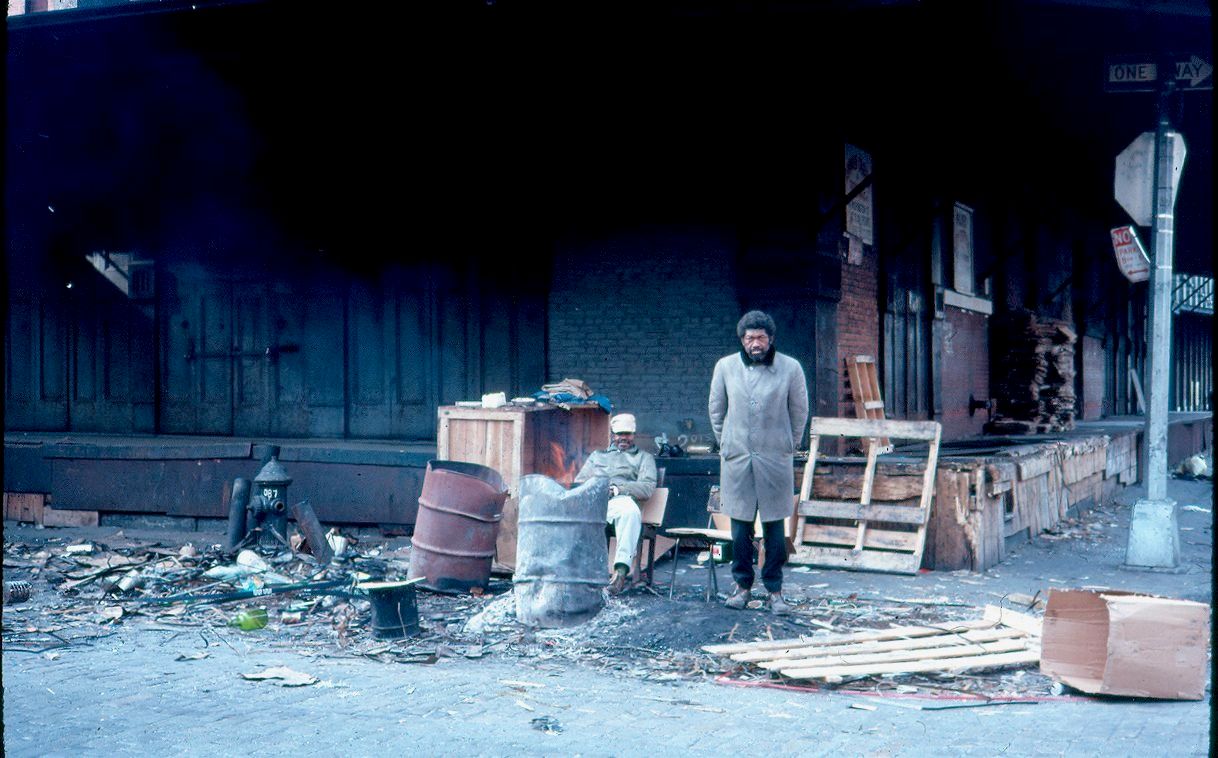
The neighborhood’s few residents knew which buildings had people living in them. They were the ones with plants in the window. In my building on Vestry and West streets lived sculptor Marisol, opera composer Robert Wilson, and pop artist John Chamberlain, best known for creating sculptures from old automobiles. On cold winter days in front of the entrance, derelicts kept warm with fires in a high oil can.
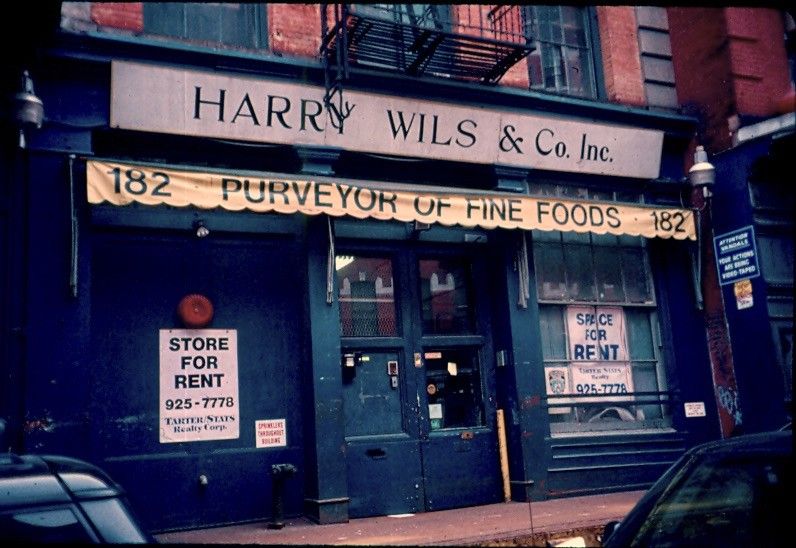
Copyright Joyce Gold
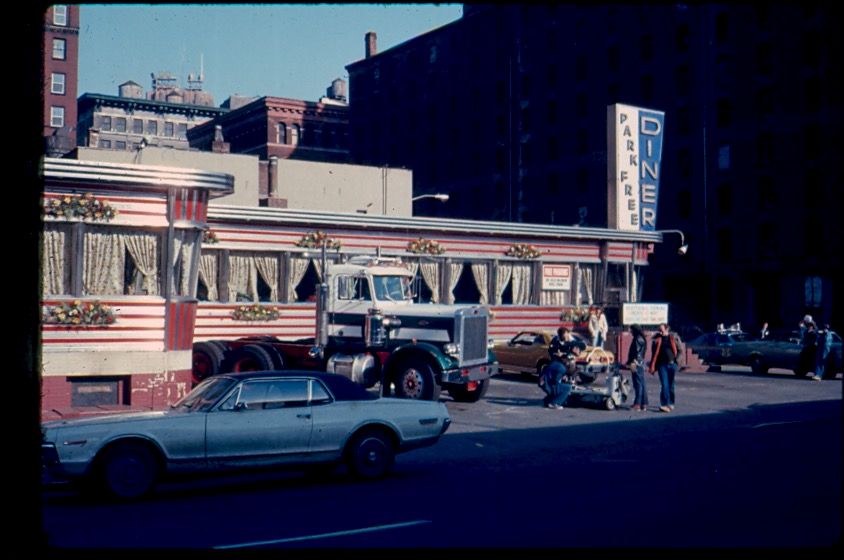
One night in front of the Market Diner on Laight and West streets, perhaps 10 stretch limos with NY and NJ license plates were parked. Presumably a high-level meeting of the mob was in session.
It was easy to find clean and useful items on the street. If you needed a piece of wood, someone would have put one out for pick-up on the sidewalk. If you needed ashtrays for parties of 100 or 150 people in your 1800 or 2500 s/f loft, you could always select a few hubcaps lost along West Street.
It was considered the safest of the 123 police precincts in the city — there were just very few people on the streets in the evening.
But times were clearly changing. Some of the residents were having children, and childcare and pre-schools began sprouting up. Robert De Niro opened the Tribeca Grill [in 1990] and cars of out-of-neighborhood diners parked around it in the evening. A decade later, in the era after 9/11, Tribeca had the most expensive residential sale prices in the city.

Copyright Joyce Gold
13 Comments
Comment:
Medium rectangle #1 (top)

Right column rectangle ads


Restaurant guide icon

It was fun recalling my days in Tribeca. The neighborhood still had remnants of its industrial days as well as signs of coming changes to make it extremely interesting. Artists are always the first to see the possibilities. Thank you, Jan, for presenting my descriptions so accurately!
Joyce – thank you so much for sharing these photos! What a gift.
Great pictures and I love the images you gave us – of the high level mob meeting, the hubcap ashtrays. I didn’t realize that it leaned so much towards industrial rather than residential. It’s come a long way! Thanks for the insights.
Many City and State agencies were located in Tribeca.
HRA at 250 Church St and other buildings, several agencies at 220 Church St. And others.
The quirky Civil Service bookstore was on Worth Street.
Bloomberg moved City agencies out of the area.
Some great Tribeca scenes in the movie Legal Eagles – Robert Redford and Debra Winger
What was the restaurant at 136 Reade Street ( had a fireplace) in 2002 winter?
We had our first Tribeca meal there after moving to the neighborhood
Was it Dekk?
I’ve lived in Tribeca since January, 1980, and hung out at the artist bars for years before that. Tribeca was magical, especially late at night, after the bars is closed, and you would walk beautiful, empty streets.
I spent eight years, ending in the early 80s, photographing lower Manhattan industrial architecture on weekends. The colors, painted by building maintenance men and not architects, and the textures, were wonderful. Now, everything is, alas, “tasteful“ beige and gray.
The Tribeca we know now is the result of the usual successful original J 51 program, which gave these buildings a new lease on life. Yes, artists were vital, but what really gave you a push into a real residential neighborhood That usually successful urban planning initiative.
In the mid 1970s I worked in a Soho restaurant. Walking home in the wee hours I’d stop at the Market Diner with its cast of odd nocturnal characters, like the three men sitting on one side of a booth. Their mustaches were dyed blue. Walking back to Chambers (and a few years later to Harrison, after I lost the loft at One Hudson St.) I’d pass the police stables. On Leonard Street you could smell the spices. So quiet at night. By day, along Canal and Chambers were fascinating job-lot stores filled with fittings and findings good for making art.
….and never forget Barnabus Rex!
I moved into a building on West Broadway and Warren Street in 1978, scheduled to be demolished next month. I don’t know what will replace it, but I will miss it as I moved out just last year.
I lived in TriBeCa since 1978 we had to go to Jersey City to Shoprite for groceries . I used to go to Maeket Diner to play Centipede. At night people would walk with drinks in hand from Puffy’s to another nearby bar .
Bell Bates sold spices . Lots of Dairy companies still doing business in TriBeCa . Kubrick’s was still roasting coffee
Ponte’s was the Italian restaurant tongontonbutnit was fancy . Maybe even needed a sports jacket (I think).
Teddy’s I think was in business in the 70’s and then it became El Internacional and then El Teddy’s with Statue of Liberty sticking up from the roof .
By 1980 new restaurants started opening . Odeon, Tommy Tang’s, Capsouto Freres, there was a punk scene and one of my favorite spots was tier 3 near west Broadway and white street. The Mud Club was super popular .
Other food spots were Hamburger Harry’s , How’s Bayou, Riverrun, Sea wok, there were more. 1990 De Niro opened TriBeCa Grill.
But back to earlier days there was Art on the Beach. We actually had a sand beach in the area that is Hudson River park now .
Then they Built the short lived Amazing Club in that area right on west and Harrison. Lots of big rats at night and loud music blasting which I think ended up closing them down .
Brill’s wines and liquor on chambers street was the place to buy wine and had great prices .
The neighborhood still continues to change .across the river we still have to Colgate clock to look at but the toothpaste tube is gone. Tribeca is still the best neighborhood in Manhattan although it’s gone from industrial to residential. Long live Tribeca
I moved here in the late ’70s. Some of the eateries I remember are in Breadshop Cafe, Tenbrooks, Delphi, Socrates and the deservedly short-lived Acute Cafe.
I lived on Duane St 1973-76 Magical times…. RIchard Serra lived on Washington St. . Gaylyn and Ed Kerns lived on Reade St on top of Thomas Azzaros roasted nuts amazing art in a pint sized loft …. Michael Vessa lived 2 buildings down….next door neigborgs across the fire escape were Paula Longendyke and Duke Delight…… Barnabus Rex was our lving room…. Mgoos was a “upscale” treked up to little Italy to do our laundry till we bought a washing machine! It was young and vibrant, wild and wonderful…