


Left rectangle ads redesigned

Robert Ripps book
History of Tribeca Buildings
City Council Primary 2025: Elizabeth Lewinsohn
We will have a primary on June 24 for our City Council District 1 seat, currently occupied by Christopher Marte. And since there are a few hot issues right now, I sent the four candidates — Jess Coleman, Elizabeth Lewinsohn, Eric Yu and of course Marte — a short list of questions gleaned from comments, along with a request for an interview. I am running the responses in the order they are returned. See the questionnaire below.
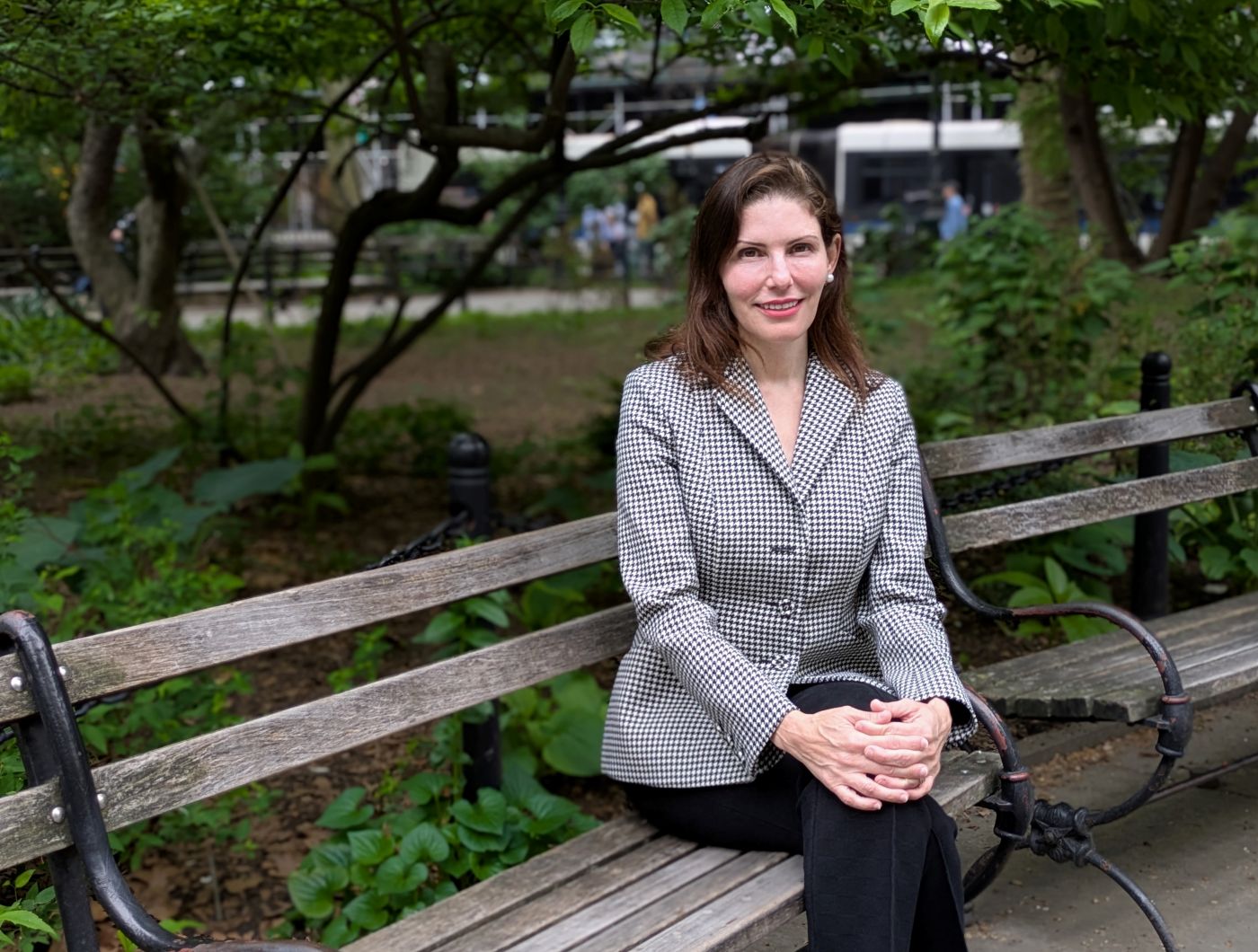
Elizabeth Lewinsohn knew after a year of law school that she would use her degree for government work and legislation, not to practice at a typical law firm. She was drawn to the policy and government subjects much more than the “black letter” classes, and pursued those interests over her three years at Yale Law School, setting her, as it turns out, on a path.
“Yale is known for this and encourages this type of problem-solving thinking,” she said. “My favorite class was called Legislation. I wrote my third year SAW (“substantial analytical writing”) paper on the the 9/11 Victim Compensation Fund. So these were the sorts of classes I enjoyed and interests I nurtured in law school.”
So when she graduated she moved to Chicago to work for the governor of Illinois. But the born-and-bred New Yorker (she grew up Orthodox on the Upper West Side, went to yeshiva in New Jersey for high school and Barnard for undergrad) didn’t last too long in the Midwest — she and her husband, whom she met in law school, moved back to the city in 20007, landing first in Tribeca and eventually Broadway, across from City Hall Park.
After 9/11 she knew she wanted to work in public safety, and her first job here in the city was as director of policy and plans for the NYPD’s Counterterrorism Bureau, where she stayed for a couple of years until her children were born. (They are now 10 and 13 and go to school on the Upper West Side.)
Elizabeth (friends call her Lizzie) joined Community Board 1 in 2013, “I wanted to be more involved in this community,” and serves on the Quality of Life and Waterfront and Parks committees, and from there got involved in what is now called Gotham Park — the potential for nine acres of public space underneath the Brooklyn Bridge — and serves as the non-profit’s chair. They will open the section called the Big Banks in a few weeks and by then will have three acres activated.
The group has also scored a commitment of $5 million for design of the rest of the park in the mayor’s budget for fiscal year 2026, and $45 million for construction for fiscal year 2028.
Running for office was never part of a long-term plan, but it became obvious recently. “In the last year I started looking at what we offer in our country and I saw the divisiveness and I thought, we need better leadership,” she said. “This is not sustainable. We need people who would otherwise not go into government. There’s less privacy as an elected official, but we need better people to step up.”
She preaches about this regularly in her office, where she has recruited a group of young volunteers to help her campaign — people she hopes will continue to stay involved.
“No matter what happens with this election,” she said, “I want it to be my mission going forward to bring good people into politics and government.”
The questionnaire:
SIDEWALK SHEDS
As you know, Tribeca is covered with sidewalk sheds, as is the rest of the city. In fact, some sheds have been up for decades! What is your suggestion for a solution? Any input on Local Law 11 reform?
I don’t think it’s an exaggeration to say that sidewalk sheds have taken over Tribeca. What was meant as short-term protection has become a long-term blight, blocking light, hurting businesses, and making our streets harder to navigate for families, seniors, and people with disabilities.
Years ago, my husband narrowly escaped being struck by a falling brick. That experience demonstrates why laws like Local Law 11 are critical. But these laws must work as intended, keeping us safe without turning our neighborhoods into endless tunnels of scaffolding.
I fully support the recent sidewalk shed reform bills passed by the City Council that shorten permit periods, increase penalties for delays, extend façade inspections, raise minimum heights, require brighter lighting, and mandate a study on alternatives like netting by September 2025.
In City Council, I will work hand-in-hand with the Department of Buildings and City Hall to make sure our district not only abides by these changes but sets the standard for the rest of the city. I will champion greater transparency by supporting a public database tracking every shed to give our community the tools to monitor progress and ensure timely repairs. I’ll also support laws that incentivize new technologies to replace or shorten the duration of sheds.
As your councilmember, I’ll fight to give New Yorkers their sidewalks–and sunlight–back.
TOWER PLANNED FOR IPN
Stellar Management and Vornado have proposed a 900-foot tower for the low-rise part of Independence Plaza on Greenwich and Jay. What is your reaction to this plan? How would you get involved in the discussions on this as-of-right development? What is the tallest new building you would support on the site?
All responsible development involves careful balance. Over the last few years, our district has built less housing than nearly anywhere else in Manhattan. As a result, we have an unmatched affordability problem with Tribeca topping all of Manhattan with a median rent of $8,300 per month. That’s way too high.
At the same time, we deeply cherish Tribeca’s historic charm and distinct neighborhood character. The skyline here is unique, and that’s part of its appeal. Developers, even when exercising as-of-right construction privileges, must be sensitive to preserving the attributes that make our neighborhood special. New construction should be thoughtfully contextual and appropriately scaled to harmonize with existing structures.
As councilmember, I will build on my prior experience chairing Community Board 1’s Tribeca Committee, proactively bringing together residents, tenant advocates, preservationists, and developers to ensure meaningful community benefits. These might include genuinely affordable housing, public open spaces, enhanced school infrastructure, or improved transit access.
The Independence Plaza development is a perfect example of why the public deserves transparency. We should know how much affordable housing will be included and what improvements are planned that can benefit the broader community. Developers haven’t been clear, and that must change. At the same time, after years of inaction, we can’t afford to turn down affordable housing. We need bold, responsible solutions to fix this crisis.
I will fight to ensure that every new development delivers real benefits–more affordable homes, stronger schools, better transit, and vibrant public spaces–while preserving what makes Tribeca so special.
PARKING PLACARDS
Cars with fake parking placards clog our local streets every day, blocking commercial parking and creating problems not just for residents but for businesses trying to get deliveries. There are times when entire streets are blocked as a result. Do you have a solution for this?
Parking placard abuse is a theft of public space and must be treated as such. It takes up vehicular parking spots, blocks space meant for businesses that rely on deliveries, and sends the wrong message that some people are above the law.
The responsibility for reporting placard abuse shouldn’t fall on residents. We need to digitize placards and link them to license plates so traffic enforcement agents can immediately ticket and remove them. This technology already exists with apps like ParkNYC.
I’ll push the Department of Investigation to target repeat offenders, especially public employees who abuse the system. And one of the many ways we can improve 311 is to let citizens track whether complaints about placard abuse have been acted upon.
I’m running to address problems that should’ve been solved long ago. Our streets must work for everyone, not just the privileged few. As your councilmember, I’ll fight to make them safe, fair, and accessible for all residents.
NEW WHITE STREET JAIL
The Manhattan site for the borough-based jail in Chinatown is now fully demolished and renderings have been released along with a new cost estimate of $3.7 billion, up from $2.1 billion. And the completion date is now 2032. What is your hope for this site? How should the city proceed?
What started as a plan for a “modern, humane jail” has turned into a $3.7 billion boondoggle and the community is right to be outraged.
Just because the demolition has already happened doesn’t mean we have to quietly accept what comes next. We owe it to the next generation to hit pause and take a hard, honest look at this project before any more damage is done.
That starts with a full public audit. Where is the money going? What alternatives were seriously considered? Why is this plan still moving forward when the people most affected have been raising red flags from the very beginning?
Chinatown and Lower Manhattan have already carried more than their fair share of the City’s infrastructure burdens, from jails to shelters to construction sites that seem never-ending. Our community deserves a voice and respect.
Any future development on this site must be scaled appropriately, shaped by real community input and guided by transparency every step of the way. Otherwise, we’re just repeating the same top-down mistakes that have already hurt residents and fractured trust.
COUNTERFEIT GOODS SELLERS
The crowds of counterfeit luxury good sellers along Broadway and Canal frustrate residents as much as they seem to attract tourists. Do you think this has to be a priority for local policing? And if so, what is your proposed solution?
The explosion of counterfeit goods sellers is precisely the kind of quality-of-life issue that has gone under addressed for too long. Our sidewalks should be safe, welcoming spaces, not overcrowded by counterfeit goods sellers. When counterfeit vendors take over parts of Broadway and Canal, the result is an erosion of public space and harm to our local small businesses. It’s time for increased enforcement which shouldn’t only target the vendors on the street, but should go after the root cause of the problem which are the larger operations and supply chains profiting from these illegal activities.
We also need to focus on keeping our sidewalks clear. High foot traffic areas need a coordinated effort from all city agencies, not just the NYPD. The Department of Transportation and Department of Consumer and Worker Protection should consistently enforce vending rules and reclaim public spaces for the people who live and work here. The City must also provide meaningful support for legitimate street vendors, including permitting assistance and clearly designated, safe vending zones.
Our sidewalks must remain accessible, safe, and equitable for everyone. We can’t continue to let one of NYC’s most iconic corridors devolve into a congested free-for-all.
CONGESTION PRICING
How do you think congestion pricing is working out so far? What are the benefits and issues for the neighborhood, as you see it?
Congestion pricing is delivering important benefits: reducing traffic, improving air quality, and providing critical new investment for our transit system. But the rollout has serious flaws that must be addressed.
The system as it stands unfairly burdens residents and small businesses within the congestion zone. Local residents account for only a small fraction of the vehicles entering the zone, yet many face real financial hardship simply trying to commute to work, shop for groceries, or attend essential appointments.
First, we must make it easier for residents to access the relief that already exists. The current maze of low-income discounts, tax credits, and disability exemptions is difficult to navigate. I’ll fight to simplify this process, eliminate unnecessary red tape and ensure that support reaches those who truly need it. Clearer rules, streamlined applications, and better public outreach are essential to make sure the system is equitable and broadly supported.
Beyond fixing the current shortcomings, we need additional safeguards. I’ll advocate for expanded exemptions and rebate programs to better protect more residents. I’ll also push for targeted small business relief, including exemptions or credits for businesses that provide essential services to the community. Additionally, I’ll hold the City accountable for making sure congestion pricing revenue is used as promised to improve the public transit system.
Congestion pricing can be a major win for Lower Manhattan and the entire city, but only if it is implemented with real attention to the needs of the communities most affected.
HOMELESS SHELTERS
As you know, the city’s homeless population has increased in the past year, and this neighborhood has, along with many others, seen an increase in people living on the streets. The city has opened a new Safe Haven shelter in the Financial District and has two more coming online soon in the Civic Center. Residents have been opposed to all three, but most vocally the one site next to the Peck Slip School on Pearl Street. What is your approach to this issue?
Safe Haven shelters are vital, but the one on Pearl Street, directly adjacent to Peck Slip School, raises serious concerns. This shelter shares a wall with a public school, and its outdoor smoking areas are too close to school grounds. We can’t risk exposing young children to adults in crisis or secondhand smoke. It’s time for consistent guidelines for siting shelters, especially if they’re proposed near schools or other vulnerable populations.
As a member of the Quality of Life Committee on Community Board 1, I’m committed to finding solutions that balance compassion with common sense. Council District 1 has shouldered a disproportionate share of the City’s shelter placements, often without sufficient community input or safeguards.
As councilmember, I’ll push to ensure that the Pearl Street Safe Haven shelter never opens and demand a more thoughtful, transparent process for siting future shelters. Housing solutions must be dignified and designed to support both those in need and the broader community. We know that homelessness won’t be solved by warehousing people. The answer needs to be more affordable housing, increased mental health care and coordinated supportive services.
CRIME
Many readers feel there has been a rise in crime since the pandemic (and statistics support that) and not much has been done about it. What is your approach to community policing? This could include policies to address violent crime, muggings and burglary, as well as “minor” issues like graffiti and other vandalism, public urination, counterfeit sellers who take over areas of Canal Street.
My experience working at NYPD Counterterrorism has taught me what it truly takes to keep our residents and neighborhoods safe. Real public safety isn’t just responding to crime, it’s about preventing it. This requires building trust and engaging directly with the communities we serve.
We must rethink how officers interact with residents. Community-centered policing means officers stepping out of their cars, walking the beat, speaking with neighbors, and building relationships with local businesses. A consistent, visible presence strengthens bonds and provides genuine reassurance.
We also need a comprehensive strategy addressing not only violent crime but also daily quality-of-life concerns, such as graffiti, public urination, and illegal street vendors. Though these may seem minor, neglecting them steadily erodes community safety and stability.
We know, however, that the police force is already stretched thin and is often tasked with handling situations–like mental health crises–for which they’re not adequately trained. We need to redesign our emergency response to include mental health professionals who can allow police officers to spend more of their time preventing crimes.
As your councilmember, I’ll advocate for a modern approach to public safety, one that addresses underlying issues, listens to residents, and genuinely protects and supports our entire community.
SUPPORTING LOCAL BUSINESS
As you know, Tribeca residents really value our local restaurants and shops, which we believe give the neighborhood much of its character. We are worried about the challenges for them from two consistent forces: real estate costs and city regulations and fines. Do you have any solutions for protecting small businesses from the pressures of rising real estate costs? Do you have any ideas for addressing retail vacancies?
Tribeca’s small businesses are the heart of our neighborhood. These storefronts create jobs, shape our streetscape, and give our community its unique character. But today, these businesses are under siege. They’re struggling to survive under the weight of skyrocketing rents, excessive fines, and outdated city regulations.
I’m grateful to this publication for putting numbers on the problem. Vacant storefronts have gone from 100 in 2015 to 240 in 2024, with 35% chronically vacant. The result is a loss not only for the businesses that could be thriving in the spaces, but for all of us who live here.
As councilmember, I’ll fight to give small businesses a fair shot at staying open. My family used to fill its prescriptions at Kings Pharmacy. Its shuttered storefront has stood empty for two years right in the middle of Bogardus Plaza. We also just lost Gee Whiz diner, which had sponsored teams in Downtown Little League and Downtown Soccer since both started. Do we want a neighborhood with no diners or local businesses? That’s where we’re headed if we don’t change our approach.
I’ll start on the City Council by championing a storefront vacancy registry with penalties for landlords who leave spaces empty for years. We also need regulatory reform from the City Council. We must modernize zoning to allow more flexible use of space, whether that’s for childcare, culture, or community services. Government can encourage the use of vacant spaces for temporary retail experiences, such as pop-up shops and art installations. This would not only activate empty storefronts but also allow entrepreneurs to test business concepts. I’d also support government loans and grants to help small businesses deal with rent increases.
City enforcement must also start to work with small businesses, not against them. I’ll advocate for fairer, more transparent enforcement, especially for minor or first-time violations, so that small business owners aren’t penalized for honest mistakes.
When we fight for small business, we’re advocating for a stronger, more connected community, one where local entrepreneurs can thrive and every storefront tells part of our shared story.
17 Comments
Comment:
Medium rectangle #1 (top)

Right column rectangle ads


Restaurant guide icon

Should be mentioned that Lewinsohn opted out of public financing at the last moment and is raising money from ultra wealthy people outside the city (and likely spending a large chunk of her own money as well). She is almost completely invisible and doesn’t show up to many of the forums that the other candidates have been in.
Also, many of these answers are super vague and playing both sides. Why the vague answer congestion pricing? What “exemptions” are you talking about?
I’m so tired of politicians trying to buy races and not actually standing up for anything in particular. I’m a former Marte voter and was considering Lewinsohn in this race, but it’s clear after seeing all these interviews that Jess is the right candidate. Don’t agree with him on everything, but he’s the only one who gives clear answers, knows what he’s talking about, shows up, and actually seems to stand for something.
“Bland” is the word that comes to mind with everything I’ve seen for this candidate…
Elizabeth Lewinsohn is a breath of fresh air that we need in the City Council! She has the experience and passion to bring change to our neighborhood necessary to move forward- not just lip service. I can’t wait to vote for her next month!
Thank god we have a rational, clear-thinker for a candidate. Her ideas make a lot of sense to me. Marte has done nothing for this neighborhood and only cares about his social justice causes, which do not reflect the beliefs of most in this district. Lewinsohn has my vote. We need change for the better in this community.
This is a great interview, thank you! I’ve met Elizabeth in person several times and really appreciate all the work she’s done for Gotham Park. She’s a great person and candidate.
“Congestion pricing can be a major win for Lower Manhattan and the entire city,” says Lewinsohn. Guess what — it already *is* a big win, and the benefits will only grow as the congestion revenues are invested in modernizing mass transit.
Lewinsohn says she’ll “hold the City accountable for making sure congestion pricing revenue is used as promised to improve the public transit system.” Guess what — CP is a state, not city program, a key distinction that any serious candidate understands. And the revenues are already earmarked for the transit improvements Lewinsohn purports to want: subway station elevators, modern signals allowing greater train frequency, and so on.
Lewinsohn seems oblivious to the Trump administration’s threats to shut down congestion pricing. Leading her remarks by claiming “serious flaws” undermines the united front NY needs in order to keep this singularly successful public policy.
The only council candidate who gets this is Jess Coleman, which is reason #1 he’s had my support from Day One and will get my vote on June 24.
To Komanoff,
You’ve been closely involved with CP for years.
But if I may ask – is CP the only issue of concern for you?
Seems to me there are many worries about NYC.
@JSL: Apologies for taking a long time to reply. Your comment flashed across my screen last weekend but fell off my browser, then I was out of town …
Congestion pricing is far from my only issue of concern, especially now that it’s in place. I’m very pro-housing — to pick one issue — and hope to get visible on that front.
What motivated me to criticize city council candidate Lewinsohn on CP is that her complaints signaled a lack of seriousness. As I and many others have repeatedly pointed out here, CP should be a no-brainer for CD1 reps. While I feel for residents who are getting tolled, there is justice in their paying for their congestion causation. Centering their personal costs at a time when electeds need to be wholeheartedly backing the program is a terrible look on Lewinsohn’s part.
In other words, CP is a telltale. Lewinsohn failed, signaling to me that I can’t trust her to represent our district.
Regarding the White Street Jail, Council Member Christopher Marte has fought against this project from the beginning. I am not aware of anything Ms Lewinsohn did as a Community Board member to comment about it. I also find it ironic that her campaign literature includes an endorsement from former Council Member Margaret Chin whose vote for the jail was instrumental in getting it built.
I guess he is just not very effective . . .
Christopher Marte is the most effective City Council member this district has had. He cares deeply about his constituents, he is responsive, he is at the center of every good fight, and he deserves another term to continue his excellent work on behalf of our community. City Council candidates who opt out of matching funds are basically trying to buy their seats. They also skew the whole race, forcing their opponents to raise more money. Please take a good look at Christopher Marte’s record before you vote.
I think it’s irresponsible to cover this race and not mention that Lewinsohn has spent over $150,000 of her own money on this race and is not participating in public financing like most City Council candidates. That alone is disqualifying to me. Get money out of politics!
Elizabeth sounds like a rational candidate and has good views. She has my vote. I have found Marte totally ineffective and a big disappointment.
Finally! Someone who doesn’t waffle around the edges and gets the fact that our streets are our homes in NYC and that if they are not regulated, it all falls apart.
Get rid of the vendors, crack down on crime, clean up the garbage and for heaven’s sake, enough with the ridiculous decisions like a men’s homeless shelter next door to an elementary school!
Rational decisions all. So, she spent her own money instead of mine to run for an office that I will pay for out of my taxes? Good for her! That’s a win in my book.
Marte’s focus on the city-wide progressive agenda may have endeared him to the Council’s self congratulatory and ineffective leadership, but has done zero for the neighborhood. Time for a change!
Agree on Marte, but there are other candidates in this race actually courting the community rather than pumping their own money or seeking donations from ultra wealthy people in Connecticut. Coleman has more than doubled the amount of donations compared to Lewinsohn, he’s actually out there all the time interacting with our community, not just rich people.
Part of the problem with Marte is that he isn’t actually accountable to the rest of the district outside the Lower East Side. You want to be represented? Go for someone actually courting our votes down here, rather than trying to buy them.
I suppose these answers are better than Marte’s would be, but man that’s a low bar.
“The system as it stands unfairly burdens residents and small businesses within the congestion zone. ” No it doesn’t. It burdens drivers correctly. Small businesses are HUGE winners in congestion pricing by being able to pay a tiny bit of money for drastically sped up delivery times. I would have loved to hear how she would have voted on City Of Yes, though. Not to mention all the campaign slimness… our tax dollars go towards matching and the fact she doesn’t want to use them is incredibly suspicious. Happy to have donated my $10 to Jess and had him get the $80 in matching!
I am favoring Lewinshon now, but would like to know her policy on the Elizabeth Street Garden. This is very important to me and my neighbors especially since she has been endorsed by Margaret Chin.
Thank you! and the sooner I hear from her campaign the better.