


Left rectangle ads redesigned


Robert Ripps book
History of Tribeca Buildings
Action at 65 West Broadway at Warren?

M. texted last month to say she saw a cherry picker tinkering with the braces on the site of 65 West Broadway, aka 59 Warren — the hole in the ground at Warren that used to be the Racoon Lodge and Mariachi’s. I checked the city’s websites (DOB and finance, to see if it sold) and no action, and a pal who lives next door said she hadn’t heard anything.
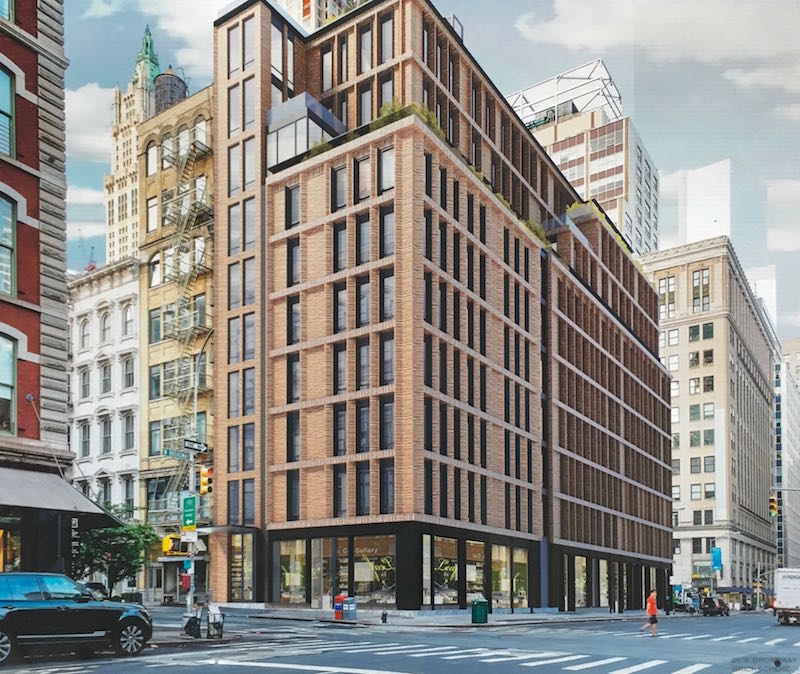
But then another neighbor caught a surveyor at work this week, and M. sent the updated permits — one filed in March with the Department of Buildings for construction of a 10-story residential building with retail uses on the lower levels, and one filed at the end of August with the Department of Transportation for use of the sidewalk.
So it looks like we are a go for new construction here? This site has the honor of being among the dinosaurs of Tribeca, since the developers have left it as a hole in the ground for nearly a decade.
In early 2023, there was a listing for the building, which looks like it’s still active. Construction originally started in early 2017 and stopped, I would say, around 2019. The site was called 59-61 Warren by the original developers (and I assume the current owners), HAP Investment Developers.
Their rendering is below.


4 Comments
Comment:
Medium rectangle #1 (top)

Right column rectangle ads



Restaurant guide icon


And you wonder why we have a housing crisis? They’re great at tearing down beautiful, 100-year-old structures. And then they go bankrupt and sit in litigation for a decade or two, wrapped up in red tape and regulation and who knows what nonsense. It’s disgraceful, and an object lesson in everything wrong with our system of government.
Why does everyone default to ‘blame the government’? A private developer bought some buildings, tore them down, caused structural damage on neighboring 100+ year old buildings and ran out of money. Which part is the government?
This is a very old city in some ways with major infrastructure issues. 20 or 30 (or whatever number) of luxury housing is not going to solve anything. Maybe if we bulldozed all of Tribeca and put up giant blocks on every street for tens of thousands of people, maybe just maybe we would put a dent in the crisis.
Sometimes that works, sometimes it doesn’t. Developments like Stuyvesant Town, Peter Cooper Village, Parkchester, etc., are still providing “middle-class” accommodations. And union-developed ones like Penn South, Amalgamated houses. and others, still fill the needs of some New Yorkers.
But some of the NYCHA plans from early mid-20th century were vastly overbuilt. Some idealist concepts from that time, like Le Corbusier’s high-rise housing blocks, had dense populations mixed with parks, etc. But critics eventually noted the failure of these area to turn into cohesive neighborhoods with lively streetscapes. One, Lewis Mumford, called Le Corbusier’s development “instant wastelands, shunned by the public.” That happened in parts of NYC, too, and at some NYCHA developments.
Jane Jacobs (“The Life and Death of Great American Cities”) advocated for active, populated and safe neighborhoods built to a human scale. So, maybe huge superblocks are not the answer. She was no fan of Le Corbusier, or Robert Moses, either.
As E. B. White noted in “Here Is New York” (1949), “Thousands of new units are still needed and will eventually be built, but New York never quite catches up with itself…” He was right.
It is an object lesson with everything wrong with “our system of government,” but maybe not the one you meant.
The delays and costs of dealing with NYC’s zoning, obtaining zoning changes, the “City of No” mentality at Department of Buildings, mandates on construction and operating costs, the litigation-friendly environment spiking property insurance costs, the costs of generous social services to any and all comers spiking property taxes, etc. etc. all lead to developers’ focus on luxury housing to turn a profit.