
Left rectangle ads redesigned


Robert Ripps book
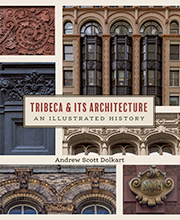
History of Tribeca Buildings

All Weight Loss is Not Created Equal: How to Lose Fat, Not Muscle, While Losing Weight

At NYLO Fitness in Tribeca, we have a lot of experience with weight loss goals and and lately, with medications like Ozempic in the spotlight, there’s been growing concern about losing muscle along with fat. The truth? Without resistance training and proper nutrition, that concern is valid. But the good news is,
it can be prevented.
When one reduces calories with a diet, nutrition plan, or GLP-1, that person will lose weight proportionately between fat and muscle mass. DEXA scan studies show that muscle mass accounts for 20-35% of every pound lost on average. However, through resistance training and nutritional adjustments we can preserve muscle mass and make sure every hard-fought pound of weight loss is 100% from body fat while staying strong.

Why Do We Lose Muscle?
The reason has to do with our evolution. We evolved in a time of food scarcity, hundreds and thousands of years ago as hunter gatherers and early farmers when famine was common. Food was scarce and we often couldn’t meet our daily calorie needs. Since finding more food wasn’t an option, our only choice was to reduce our daily caloric needs. So, the body takes a cost-cutting look at itself and decides which parts are assets
and which parts are liabilities.
Interested in Building Muscular Assets?
Apply for NYLO Personal Training
Body Fat VS Muscle: By the Numbers
- Muscle and fat cells in our bodies both use energy to stay alive.
- One pound of muscle burns between 8 and 16 calories per day.
- One pound of fat burns about 2 calories per day.
- One pound of muscle yields 350 calories when it’s digested.
- One pound of fat yields 3500 calories when it’s digested.
From the body’s perspective, muscle is high cost and low yield, while fat is low cost and high yield. Which asset would your broker advise you to sell off?

Muscle as an Asset Class
There is a big caveat regarding muscle as an asset class. One’s amount of activity and the intensity of activity. Sedentary bodies view their muscle mass as a caloric waste. If the muscles aren’t being used, they are the first to go during caloric budget cuts.
Resistance training sends the signal to the body that muscle is a productive asset. It is assisting in the trials of everyday life and the search for resources in a sparse caloric environment. Every animal goes through lean times, but human beings are the only animals who exercise. Cheetahs, for example, are very fast. But they have not been observed running sprint interval drills in the wild. Their life is their training. Hunting, playing, fleeing is their exercise.
Real Training. Real Results.
Apply for NYLO Personal Training
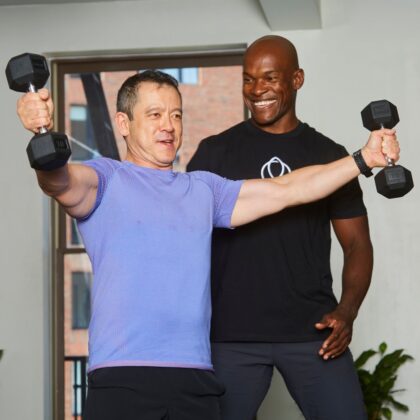
Our bodies are the same. The body still assumes that whatever physical activity we do is necessary to our survival. Therefore, if one strength trains several times per week consistently, the body will assume that it is necessary to their survival. Thus, the body will choose to preserve muscle mass during calorie deficits, using only body fat for energy.
All Roads Lead to Caloric Deficit
This is true for any kind of weight loss diet or caloric restriction. We can choose a time window to restrict with intermittent fasting, we can restrict food groups with low carb or low-fat diets, we can restrict our overall calories by counting calories, or we can restrict our desire for food with medications like Ozempic or other GLP-1s. These are all paths that lead to reducing the amount of overall calories to the point where weight loss is possible.
In all cases, to preserve muscle mass and maximize fat loss, one needs to strength train and eat an ample amount of protein, between .8 and 1.2g per pound of body weight to maintain muscle mass and maximize fat loss.
The NYLO Difference
At NYLO, we design training programs that preserve and build muscle while guiding fat loss. The result isn’t just a number on the scale—it’s a stronger body, better posture, improved mobility, and the confidence that comes from knowing your weight loss is the right kind. If you are interested in fat loss, gaining muscle, getting stronger, increasing flexibility and mobility, improving nutritional habits, and training for health and longevity.
Apply for training at NYLO Fitness.
…………………………….
Sponsored by NYLO Fitness
Medium rectangle #1 (top)

Right column rectangle ads


Restaurant guide icon