


Left rectangle ads redesigned
Robert Ripps book
History of Tribeca Buildings
Books of Tribeca: New Art, Old Buildings: Stories from Hal Bromm’s Tribeca

Before there was the Tribeca Gallery District there was the Hal Bromm Gallery at 10 Beach Street, the first commercial gallery in the neighborhood. This is how it started, 50 years ago:
“I had friends in Soho and looked around there for a space, but TriBeCa appealed to me because it wasn’t really a neighborhood,” Hal writes in one of the introductions to his new book, New Art, Old Buildings: Stories from Hal Bromm’s Tribeca. That was 1972. “It was a kind of no man’s land. Julian Pretto [who would become a noted art dealer] had taken a floor in a cheese warehouse on Beach Street for $250 a month. I took one look and signed a lease for a raw space.”
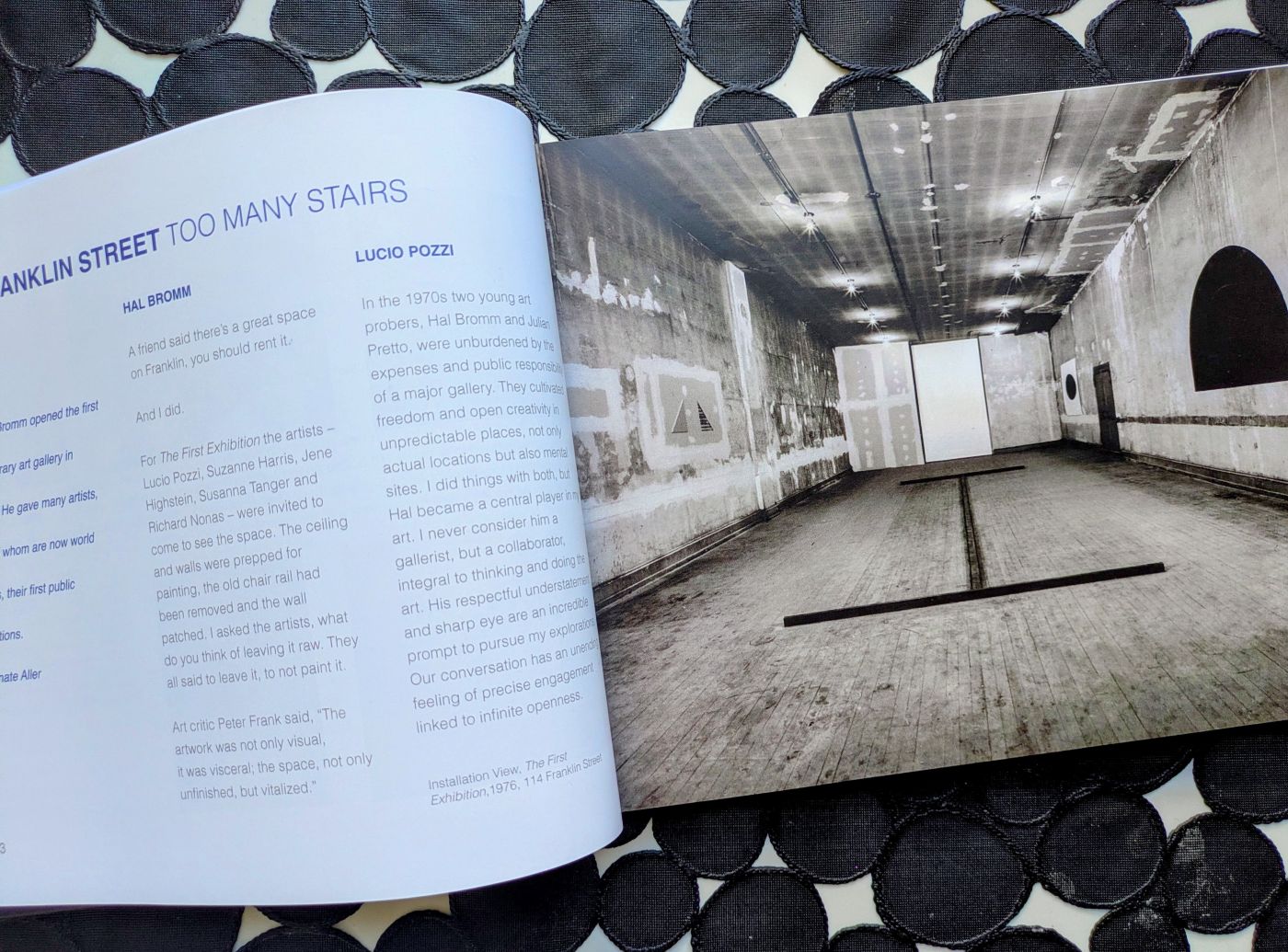
The book recounts these stories and beyond through dozens of personal anecdotes from artists and collectors, interspersed with recollections from Hal and loads of archival images.
In the early-1970s, Hal had left a job at a major architectural firm — doing the interiors for the board members and executives of Exxon — to start his own design practice specializing in interior design, space planning and art consulting. The business was born at 10 Beach. And not long after, the landlord asked if they wanted to buy the building.
“It was a no brainer,” Hal wrote. “One day I got an urgent call from the sculptor Larry Fane who had the street level space. A tractor-trailer had backed up to the loading dock and the driver was unloading crates of cheese. In spite of Larry’s protests that the building was no longer a cheese warehouse, the driver would have none of it. He unloaded all the crates and drove away. The loading dock was covered with crates of cheese stacked eight feet high. Eventually we got in touch with the company that had sent the cheese and they picked it up the next day. They were so grateful we had contacted them that they told us to help ourselves to cheese!”
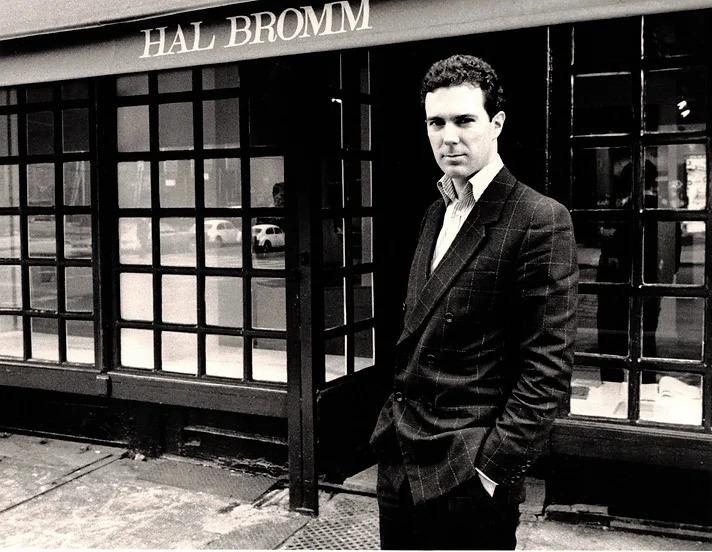
Not long after his acquisition on Beach, he spent two years in London and would return with the work of young artists he met through David Hockney; he put up a show at his loft, and when friends suggested he open a gallery, he did. He rented a fifth-floor walk-up at 114 Franklin in 1976, then eventually moved to the 14th floor of 90 West Broadway, largely for the elevator but also the views. When the building converted in 1979, he moved to the second floor and has been there ever since.
In the ’70s, opening a gallery down here was not logical — but it worked. The book is filled with recollections from artists and artist neighbors from that time on how Hal’s gallery became a meeting place for so many of them, even artists from abroad.
“The loft was white — white floors, white walls, white ceiling — except for the walk-in cheese cooler. Hal painted it black and used it as a dressing room,” writes the interior designer Mark Golderman in the book. “When you walked into the larger space you might find a John Chamberlain crushed car, a Donald Judd cube, or a fantastic screen by Rosemarie Castoro.”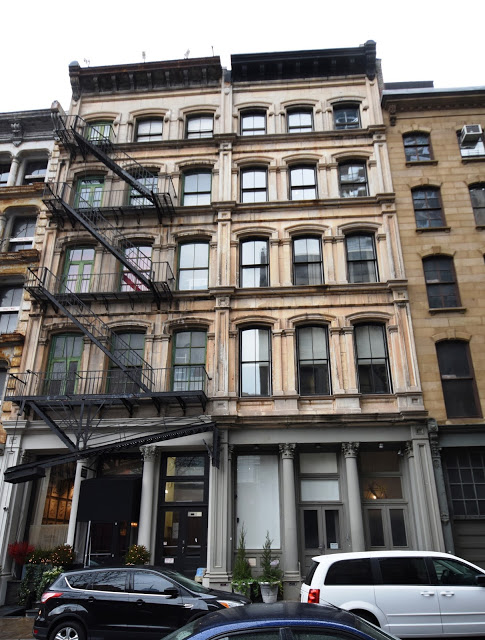
Longtime Tribecan and artist John Willenbecher, who has lived above the Odeon since it was the Towers Cafeteria, couldn’t imagine that anyone would travel all the way down here to go to an art gallery. “Hal bet they would,” he writes in the book.
“Yoko Ono, Dorothea Rockburne, Richard Lippold, Nancy Graces and Susan Rothenberg lived in the area. The neighborhood was a bustling beehive of workers during the day, but totally empty at night. If you saw anyone on the street after dark you could be pretty sure it was an artist.”
But that’s not all! Hal served on Community Board 1 for 12 years, was president of the Historic Districts Council, which ensures the preservation of significant historic neighborhoods, buildings and public spaces in the city, and created the Knowlton Township Historic Commission in New Jersey. The book’s title is not just symbolic. He is an active preservationist to this day, and we can credit him with much of the effort to create Tribeca’s four historic districts.
The back half of the book is dedicated to recollections of activists and journalists who witnessed Hal’s work to preserve the neighborhood. “If not for Hal Bromm… Tribeca would be a sea of needle skyscrapers and condos,” writes journalist and former Tribecan Joanna Molloy. “Just as Hal had futurevision with artists, he knew this neighborhood would become gentrified and Etch-A-Sketched without landmarks protection…Thanks to Hal, I learned that my own small brick building on Thomas Street was built just after the Civil War, in 1868, as a collar warehouse when men still wore stiff collars unattached to shirts.”
 His first foray into protecting Tribeca was at the intersection of Hudson, West Broadway and Chambers — what we now know as Bogardus Plaza. In 1977, the Frederick Hotel was an SRO (single rooms rented by the month, like a dorm) and Bogardus Triangle had five trees and tree pits filled with broken bottles.
“I said, ‘This is our neighborhood. We have to be in charge of it a little bit.’ So we planted bulbs and we got the bum guys who hung out there to stop throwing bottles and be stakeholders and amazingly it kind of worked. Years later Carol De Saram got a grant to turn the traffic triangle into a garden and that was the birth of the Bogardus viewing garden. At some point I inveigled Tory Weil to join our little group and she made it what it is today.”
Hal’s gallery has always been on the cutting edge for new work – showing people what was about to happen. In the 1980’s, he gave shows to several up-and-coming East Village artists, including David Wojnarowicz, Russell Sharon, Luis Frangella and Judy Glantzman. And in 1981 he gave Keith Haring his first commercial gallery show.
“The work was pretty magnetic,” Hal said in his Spotlight Q&A in 2021. “I had seen his work in the subway – he did drawings on the subway advert panels. When the ad time had expired, they would put black paper over the panel and Keith would come along with a piece of white chalk and do drawings then jump off the train and jump on the next car and do more drawings. Nobody knew where these drawings were coming from. He also liked to do drawings on found objects — he would find things on the street, paint them and draw on them.”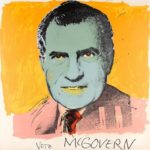
It’s worth reading the Spotlight feature, but if you want the shorthand, I love this on the “ones that got away”:
“When McGovern ran for president [in 1972] for $500 you could buy a Warhol print with the face of Richard Nixon and underneath Warhol hand wrote Vote McGovern. So I scraped together $500 and bought one. I wish I still had it. You always regret what you didn’t do and not what you did do. There was a client who came in with a beautiful Rothko and asked me to sell it and I said sure. I wish I kept it. There was a little de Kooning. There was a Cy Twombly… How big is my collection? Too big.”
1 Comment
Comment:
Medium rectangle #1 (top)

Right column rectangle ads



Restaurant guide icon


I started exploring Tribeca in the late 1970’s and began working here full time in 1980.
I remember the old hotel before it became the Cosmopolitan, then the Frederick. It’s name then was the Bond Hotel, and it’s fame was that it housed “permanents and transients. The joint, of course, was classy, as anyone who peered into the entrance could immediately see the bulletproof enclosure at the front desk!
Tribeca still had a bit of its raw edge back then, when some loft buildings had small businesses. It was not unusual to find lock and key wholesalers on Warren Street, and refugees from Radio Row on Chambers Street.
Thanks for the article on Hal Bromm and the fond recollections that it brought forward from the recesses of my memory. And thanks, Hal, for your dedicated preservation work!