


Left rectangle ads redesigned

Robert Ripps book
History of Tribeca Buildings
Looking back on a year of congestion pricing
Lots of agencies and organizations have been churning out facts about the past year with congestion pricing in place — it started on January 5, 2005 — and I will regurgitate some of them here. The highlights:
- 23.7 million fewer vehicles have entered the zone south of 60th Street than in 2024.
- Daily entries into the zone are down 12 percent — about 71,000 fewer vehicles per day.
- Commuter trips are down by as much as 21 minutes throughout the region.
- Bus speeds have increased, some routes as much as 25 percent.
- School buses are on time 72 percent of the time, up from 58 percent last year.
All these stats were compiled by Congestion Pricing Now, an advocacy coalition that includes non-profits (Environmental Defense Fund, New York Lawyers for Public Interest, Trust for Public Land, Transportation Alternatives), wonky types (Citizens Budget Commission, Hudson Square BID), developers (Two Trees) and corporations (Lyft, Sam Schwartz Engineering) among many others.
They got their data from the MTA, Bloomberg, the Regional Plan Association and about 10 other sources.
And there’s more. Crossings entering the zone during morning commutes are faster on average:
- Holland Tunnel is 36 percent faster
- Lincoln Tunnel is 10 percent faster
- Queensboro Bridge is 21 percent faster
- Williamsburg Bridge is 23 percent faster
Tribecan Charlie Komanoff had a more nuanced analysis in Vital City, where he noted that revenues are close to what was predicted (not quite $50 million vs. $60 predicted) but a bit off, and that travel speeds have not increased.
“According to MTA figures, monthly revenues minus expenses are struggling to reach $50 million. As for traffic flow, the early euphoria of freer-flowing streets has dissipated. While some rebound in traffic was expected, data culled from Ubers and yellow cabs in motion suggest that travel speeds within the zone today are barely surpassing those from a year earlier.
Nevertheless, transit trips are up, as are broader economic indicators from foot traffic to storefront leasing rates. Bonds secured by the toll revenues are enabling the MTA to install subway station elevators and speed its system-wide overhaul of track signals, promising faster and more-accessible transit which in turn portends further ridership gains and car reductions.”
It’s worth reading his full piece to get a bigger picture.
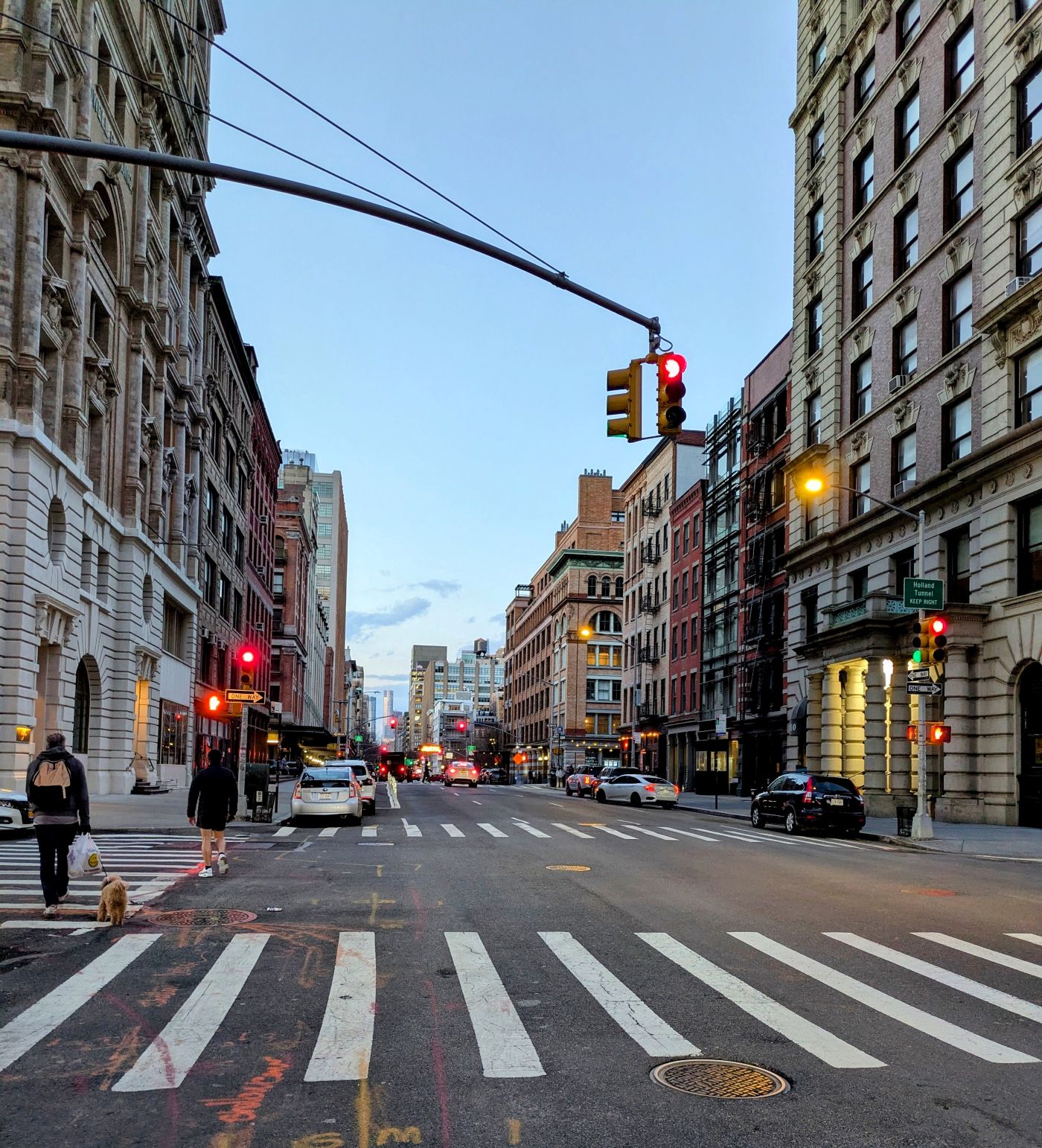
As for Tribeca, I am still in the honeymoon stage, and the data supports that. As of September, pedestrian fatalities are at historic lows having dropped 15 percent in the zone, matching levels last seen in 2018. And honking and vehicle noise complaints to 311 are down by 45 percent in 2025. Levels of harmful fine particulate matter (PM2.5) are down 22 percent. (Are the blades of my ceiling fan less grody? Hard to tell…)
Plans that were in motion, then paused when congestion pricing was almost cancelled by the Trump administration, are back on track. The MTA has also signed contracts to begin the extension of the Second Avenue Subway, which will serve an additional 110,000 people daily and add three accessible stations to the Q train. (Subway ridership is up 9 percent.)
And more people are going to work within the zone compared to 2024 — there was a 6.7 percent increase in daily workers in Lower Manhattan.
So far, so good.
9 Comments
Comment:
Medium rectangle #1 (top)
Right column rectangle ads



Mega rectangle
Restaurant guide icon


All sounds great!
Now if the city would enforce actual traffic laws and no honking laws and other noise laws (against modified engines and plastic car stereos), that would be a win-win in so many ways, including lots of ticket revenue for the city.
While honking noise is upsetting, it is transitory.
The real, pervasive and dangerous noise is loud music from neighbors and restaurants and bar. Lasts for hours, sometimes all night.
And of course typically worse in the summer.
Huge issue all over NYC.
The City does nothing.
Wow you definitely don’t get invited to parties
Didn’t stop them from raising the fares. $550 million in net revenue and the public is still paying more per ride and service is still awful!
The fare increase was implemented mainly in response to inflation, as I understand, for general operation cost.
(As anyone who deals with repairs, contractors, maintenance etc. of anything in this town (as I do) knows, the costs of everything — from labor to parts to raw materials — have increased painfully since pre-pandemic and seem to just go up and up. Some costs of repairs in our building have DOUBLED since 2019, for the same work!
Congestion pricing income is separately targeted for capital improvements and major projects.
What are the concerns about service? I’ve ridden the subway for decades and find it effective and convenient to get to wherever I need to go. Of course, in a system so large and complex, with so many uncontrollable variables (trash on tracks, humans on tracks, humans on top of trains, aging infrastructure, people holding up trains by holding open doors, etc.), there will be occasional delays, but I imagine that’s the case in any large city transit system. I suspect perfection is impossible in the face of so many variables.
Stations and trains could be cleaner, but again it’s a huge system, and responsibility for keeping them clean also rests on the riders. So much littering and vandalism. Also there needs to be serious enforcement against the fare-cheaters. Those who advocate for “free” transit must remember that nothing is free; we would still pay for it somehow, typically through higher taxes.
But overall I see the system as effective, convenient, and cost-effective. For $3 I can get to pretty much anywhere in the vast system. One reason I live in NYC is the public transit system, as it’s one of the few (or the only?) large cities in the USA where there’s no need for a car.
The complaint should be in the waste, fraud, and corruption that has been the hallmark of the MTA since its beginning. If the congestion tarrif actually produces some real, verifiable, and noticeable positives, then perhaps people might be a bit more accepting. But, until that happens, most non-idealogues will be skeptical and cynical that the money will be wasted, and the public will have been fleeced again. I, for one, do not believe the propaganda numbers that Hochuel, Lieber, Mamdani are putting out there.
An observation and question re: NYPD
Thurs. and Fri. evenings, during 6-6:30 time, NYPD cars run their sirens on congested Hudson St. and add to NOISE regularly. It appears they use their sirens, so that they can speedily turn to get back to Precinct headquarters? If this is so, what an abuse of power, and damage to quality of life, noise pollution, etc.???
How great it could be if instead, they managed traffic for the many instead of doing this for the few.
1st Precinct cars and vans do this all the time from White Street, turning north against traffic on West Broadway, and then onto N. Moore Street, to make it easier to get back to the cop shop. They have done so for decades. Terrible example set by law (non) enforcement.
This drives me crazy! Such a flagrant example of “Rules for thee, not for me”