


Left rectangle ads redesigned

Robert Ripps book
History of Tribeca Buildings
Nosy Neighbor: What is going on at Staple and Harrison?
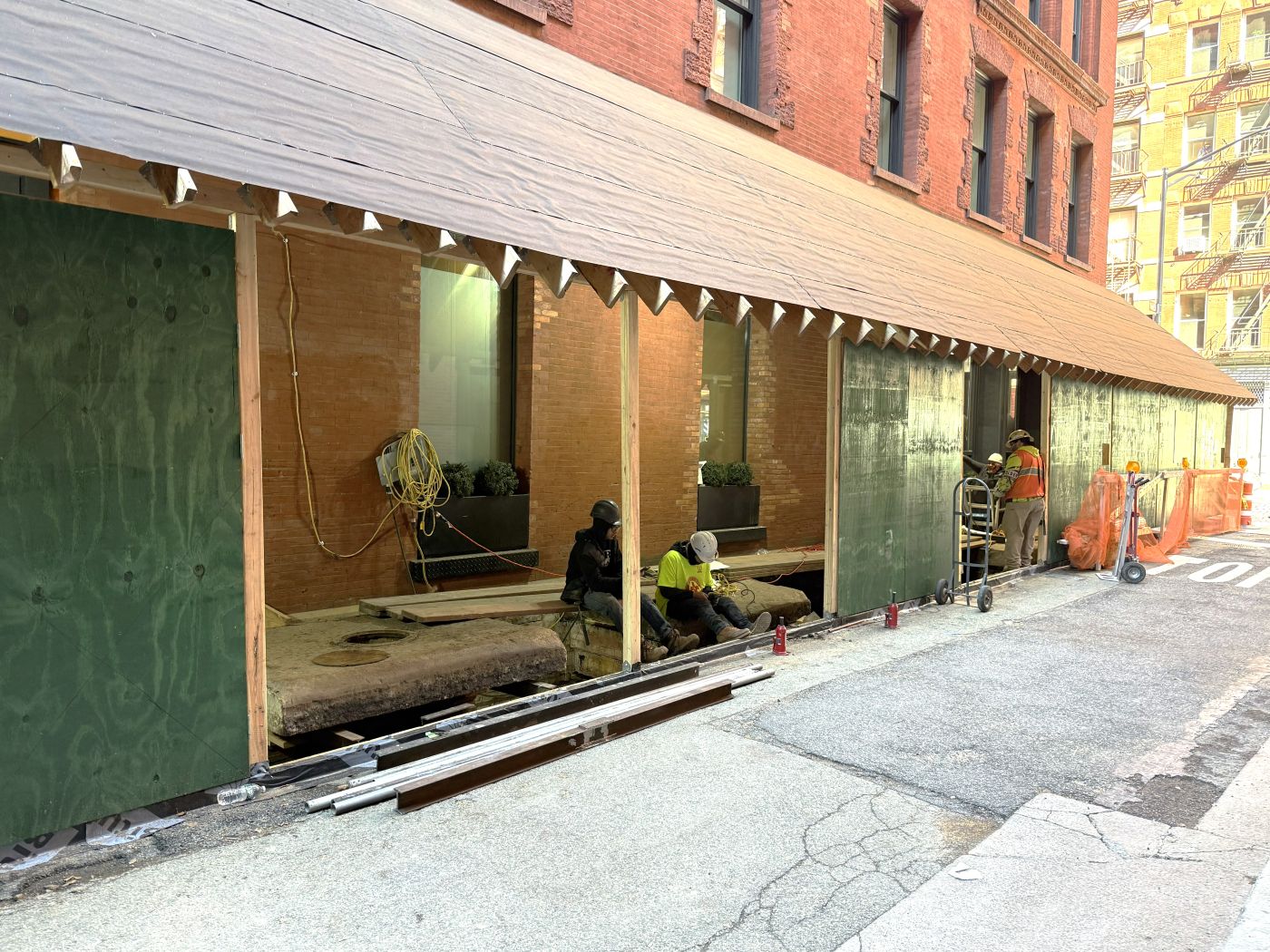
So the construction fence that has surrounded the sidewalk at the top of Staple Street at Harrison has driven me nuts for years, and it finally has a resolution.
K. wrote to say they had started work replacing the structure of the vault under the stretch of sidewalk alongside 7 Harrison: “It’s pretty cool how they are lifting the slabs out.”
Department of Building permits say that the contractors are replacing the sidewalk vault roof structure, and doing related cellar vault restoration and repair work including structural work on the outside and the cellar levels. They also have to deal with asbestos abatement, and have registered that work with the Department of Environmental Protection.
They will be using steel joists as well as concrete and masonry. The project is estimate at $910,750 — not including the $10,000 construction fence. (Yipes.)
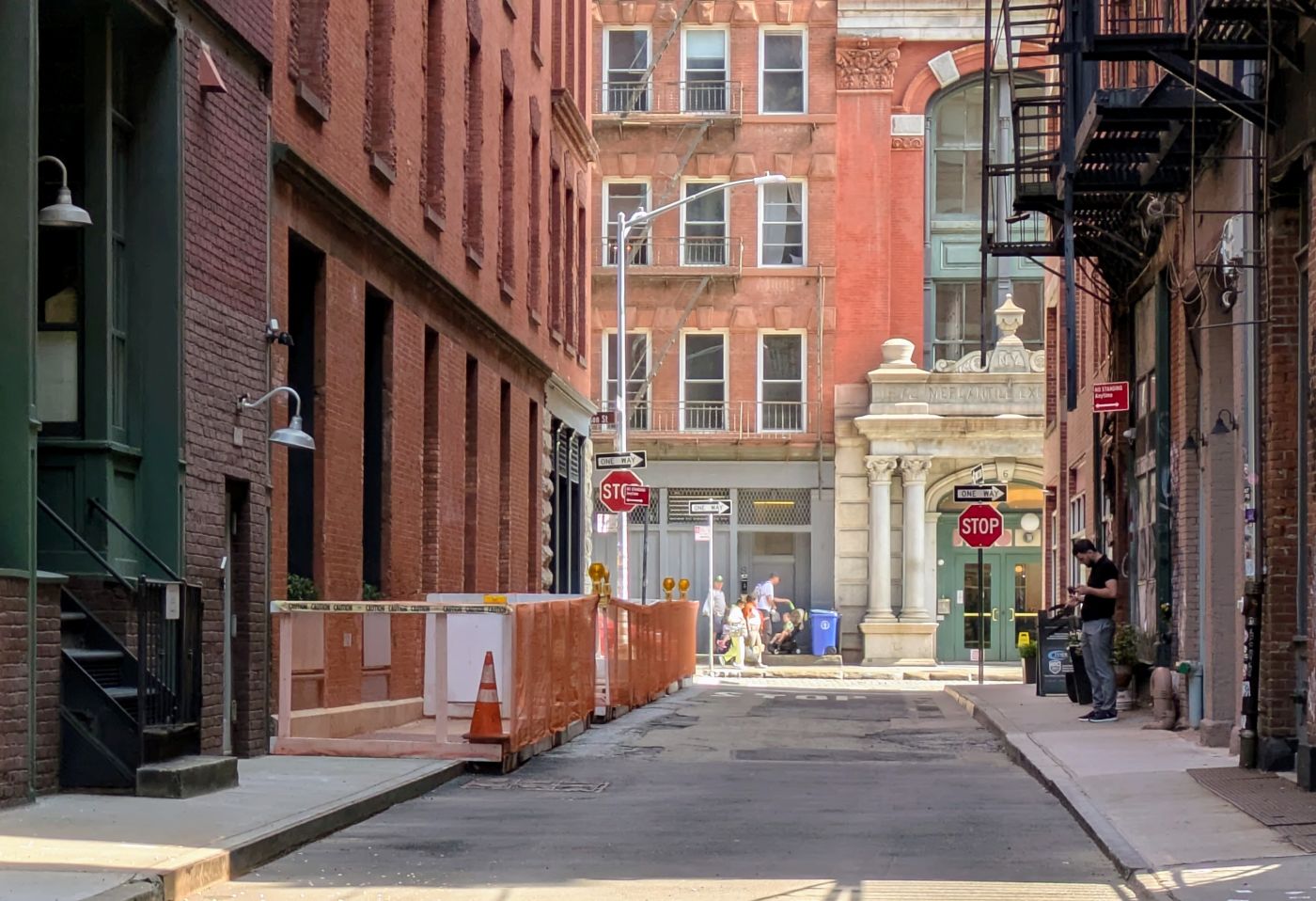
July 2025
The building, built is 1894, is a condo, and was designed by longtime Tribecan Steven Harris. According to StreetEasy, there are 12 units with 3- and 4-bedrooms; men’s suit maker Alton Lane is on the ground floor. Starting in 1906, it was the home of the Harrison Street Cold Storage Company and retained that use until the mid-20th Century.
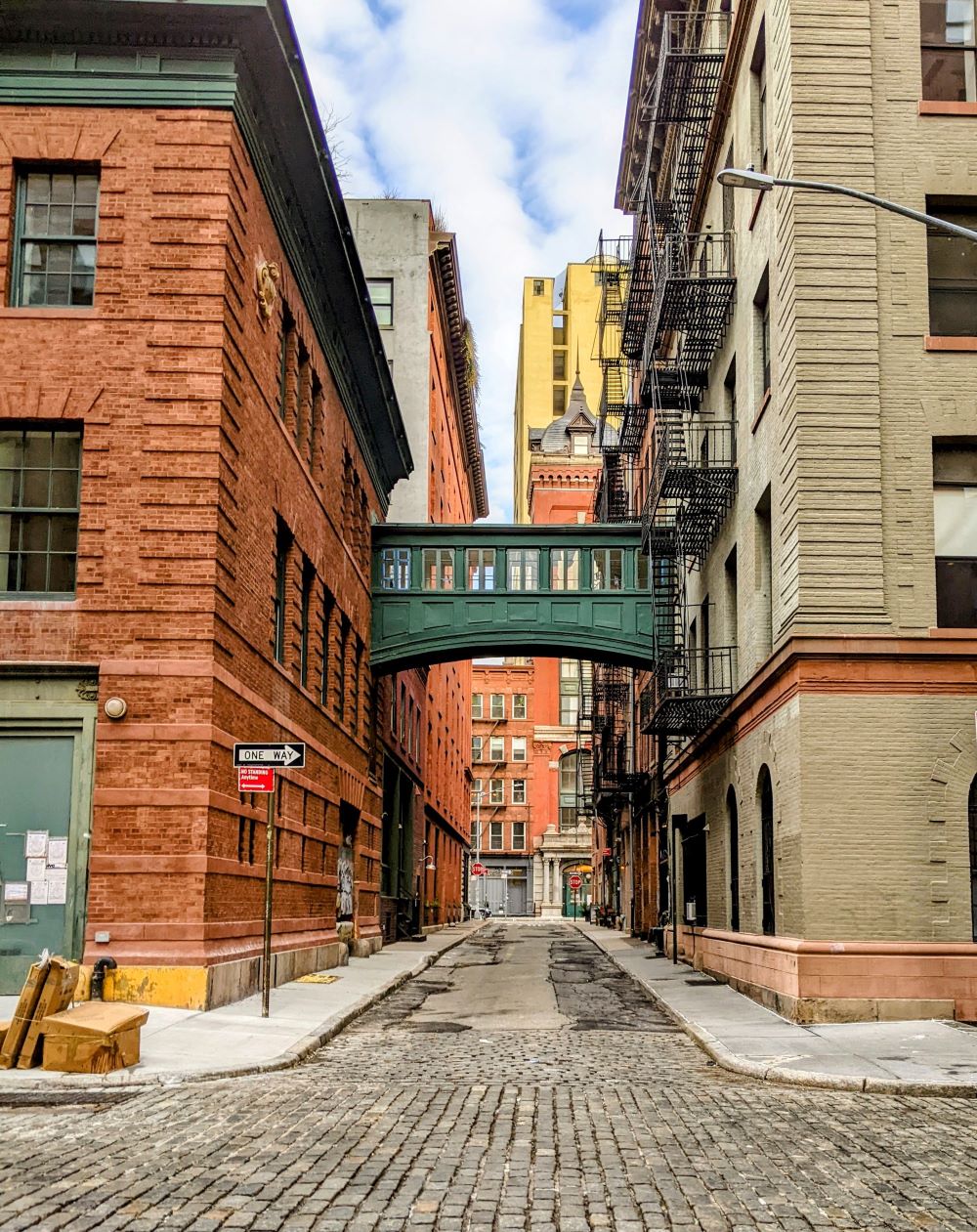
This made me go looking at the designation report for the Tribeca West Historic District to read more about Staple Street. And here we go:
Narrow, alley-like Staple Street appears to have been laid out as a twenty-foot wide private street, extending from Duane Street to Harrison Street, when the Trinity Church property known as the “Church Farm” was lotted and sold at auction in 1797. While it was not named by the Vestry of Trinity Church at the time when nearby streets were named, the alley soon became known informally as Staple Street.
In 1803 and 1811, when owners of property in the immediate area requested that Staple and Harrison Streets be graded and paved, Staple Street was considered by the Common Council to be a private street not ceded to the City. Although the street perhaps was intended originally as an alley providing access to stables at the rear of houses facing Hudson Street, the street came to be used for a variety of other purposes. The rear of the lot acquired by grocer James Amar in 1797, on which was constructed one of the earliest buildings on the street (4 Staple Street), was used as a coal yard in the first decade of the nineteenth century. Mid-nineteenth century maps indicate that the street was lined with small buildings on the rear portions of the lots facing Hudson Street, housing fire-hazardous businesses such as blacksmith shops rather than stables; from the mid-nineteenth century on, these structures were replaced by buildings which extended through the block between Hudson Street and Staple Street and larger buildings facing Jay and Harrison Streets.
The origin of the name of the street remains unclear… [But there are two potential options.] Since many of the streets in the area were named for persons associated with Trinity Church it is possible that this was also the case for Staple Street. A likely namesake is John J. Staples, who resided in 1799 in a large residence on Pearl Street. In the 1810s Staples owned property on Hudson Street just south of Harrison Street, a residence which he leased. Since this lot did not extend through the block to Staple Street and his known title to the property postdates the naming of the street, Staples’ original ownership of or association with the street, which was private at that time, remains undocumented.
Historians have suggested that the name originated in the Dutch colonial era, referring to the colony’s right to collect a duty, or “staple,” on tobacco exports. Shipmasters of other nationalities who declined to pay the Dutch duty were required to sell, or staple, their cargo. Given the distance of the street from both the area of colonial New Amsterdam settlement and the North (now Hudson) River, however, and the lack of evidence known to date linking the staple selling of tobacco with the Staple Street area, it seems unlikely that the name of the street has a Dutch-era derivation.
The early 19th Century character of the street, with wood-frame and masonry service buildings, began to be dramatically altered in the mid-19th Century. No. 171 Duane Street, on the west side of Staple Street, was enlarged and faced with a cast-iron facade in 1859-60. At this same time a six-story store and loft building was erected at 6 Staple Street (replaced in 1893-94). The American Express Company freight depot and stable was established on the north half of the block bounded by
Hudson, Jay, Staple, and Duane Streets in 1867, and on the block to the north the store and loft buildings at 73 and 75 Hudson Street, extending through the block with elevations on Staple Street, were erected in 1867-68. At about this same time a brick facade appears to have been added to 4 Staple Street, across the street from the store and loft buildings.
A second wave of redevelopment of the street was initiated with the construction of the Schepp Building (47-53 Hudson Street) in 1880-81; at this same time the store and loft building at 73 Hudson Street was erected. In 1888 a store and loft building at 3-5 Harrison Street (Martin V.B. Ferdon) was constructed for jewelry merchant Charles S. Welsh, who in 1893 with a partner commissioned the same architect to design the store and loft building at 77-79 Hudson Street. The construction of the present American Express Company Building (55-61 Hudson Street) in 1890 and the store and loft building at 8-12 Jay Street in 1896 completed the streetscape of the southern block of Staple Street.
The construction of the store and loft building at 7-9 Harrison Street in 1893, the enlargement of 71 Hudson Street in 1896, and the remodeling of 4 Staple Street in 1900 completed the late nineteenth-century commercial redevelopment of the northern half of Staple Street.
During this same period of building activity, the New York Hospital building, later known as the House of Relief, was erected at 67 Hudson Street, occupying the entire southern portion of the block. The hospital stable and laundry building was completed on the west side of Staple Street (9 Jay Street) in 1907; a second-story iron footbridge was added later to join the two buildings.
The cold storage business was active at the northern end of Staple Street. In 1899 No. 3-5 Harrison Street was altered for use by the Harrison Street Cold Storage Company for use as a cold storage warehouse. No. 4 Staple Street was acquired by the same firm in 1900. The building at 7-9 Harrison Street was converted for cold storage use in 1906 and became one of the main facilities of the Harrison Street Cold Storage Company, which was taken over by the Merchants’ Refrigerating Company in 1913; the building housed one of the firm’s main cooling plants. No. 7-9 Jay Street remained in use for cold storage through the mid-twentieth century.
Staple Street retains much of its historic character and has been little altered since the turn of the century. The only significant change in the streetscape was the demolition of 3-5 Harrison Street in 1967 which left a vacant lot at the north end of the street.
Comment:
Medium rectangle #1 (top)

Right column rectangle ads




Restaurant guide icon