


Left rectangle ads redesigned


History of Tribeca Buildings
What Cuomo has said about the White Street jail
Mayoral candidate Andrew Cuomo has taken a stance on the borough-based jail issue, saying we should rebuild Rikers *on* Rikers Island and rebuild the borough sites as housing and, well, he’s right! Here’s my post from 2021 suggesting just that, and the 2022 plan from local architect Bill Bialosky (and a team), that outlines a real plan for the same.
It started with his scripted comments during the Crain’s mayoral forum on October 8: “Let’s make a major start by stopping a major debacle,” he said of the borough-based jail plan. “It promises to be New York City’s big ditch. It is already years late, billions over budget, and obsolete. We should rebuild new state-of-the-art jails on Rikers Island, provide free bus service, and use those sites for housing and commercial development.”
And he got into more specifics in an op-ed in amNY last week: “Rikers Island as it exists today is a human-rights failure—outdated, unsafe, unacceptable…We need a plan that works for safety, and for taxpayers. My proposal does exactly that: rebuild modern, humane facilities on Rikers Island in phases while converting the four borough jail sites into affordable housing and mixed-use development that will improve our neighborhoods.”
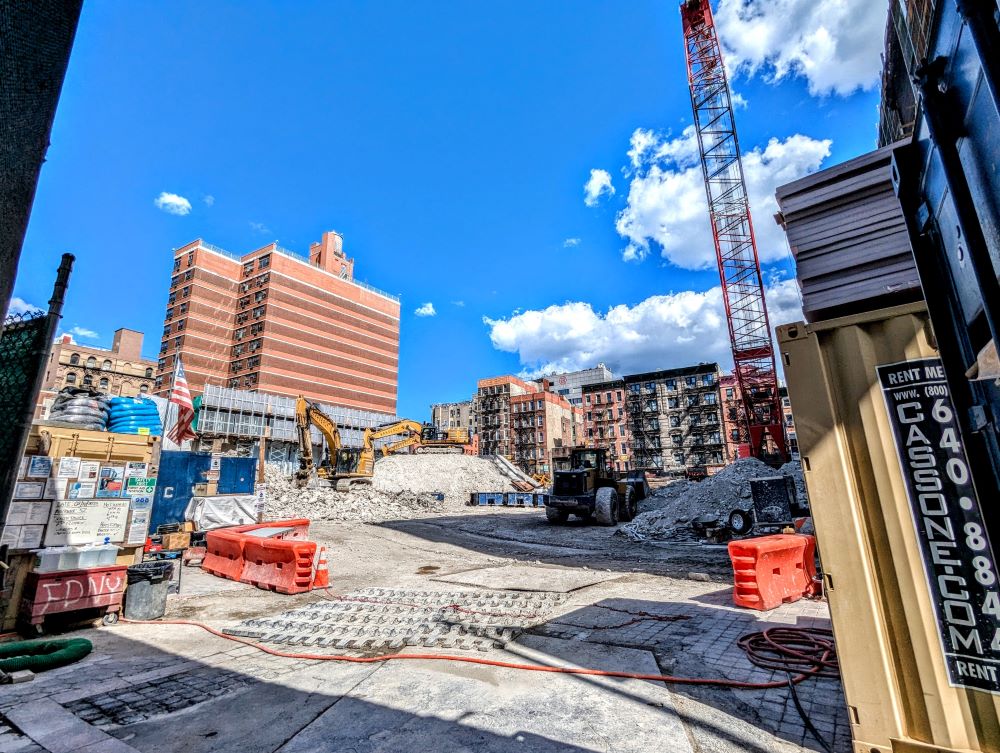
He notes in the op-ed that the borough sites are big, close to transit and shovel-ready.
“Working with local leaders,” he wrote, “we can deliver affordable housing, childcare, retail, open space, and job-creating mixed-use projects tailored to each borough’s needs. Instead of erecting four fortress-jails in residential blocks, let’s build neighborhood assets that families welcome.”
The plan to build the jails is from 2017, a project of then-mayor Bill de Blasio. The commitment hinged on shuttering Rikers by 2027, and clearly that ship has sailed. The new estimate for completion of our jail in Chinatown is 2032, and the budget has swelled from $2.13 billion (what I reported in 2023) to $3.7 billion.
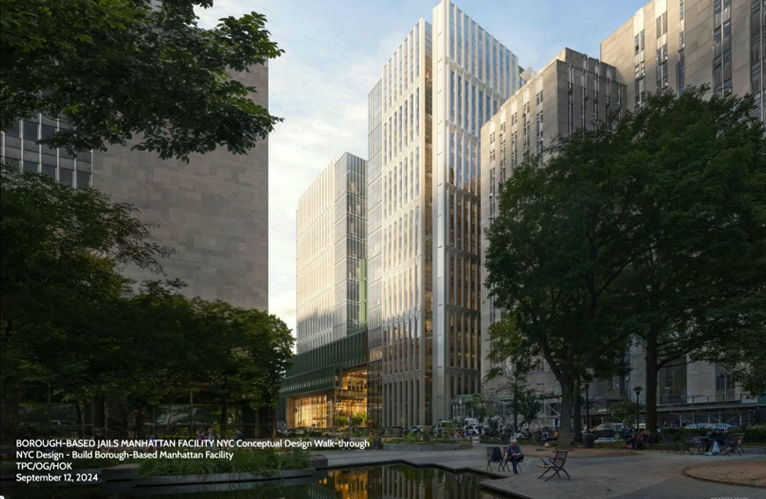
Plus, the plan counted on the prison population shrinking; the four borough-based jails together will offer 4200 beds. The City reported in March that the population at Rikers has only grown, and is now over 7000. (Even the city’s own FAQs on the jail population have not caught up with this fact, and have not been updated in four years.)
Plus plus, the city has not cooperated with the public, releasing renderings to the media before showing them to local residents, who are organized and easily reachable.
Plus plus plus, time is of the essence: plans were filed with the Department of Buildings on October 17 to start foundation work on the high-rise jail — 1,039,645 square feet of it. They will be digging 45 feet down.
I would like to think, no matter who the next mayor is, that it’s not too late for saner minds to prevail.
12 Comments
Comment:
Medium rectangle #1 (top)

Right column rectangle ads


Mega rectangle

Restaurant guide icon


I was sitting on the fence w/these two—thanks for helping me make up my mind!
This is getting silly, and Cuomo is just being his typical, cynical, self-interested self.
Construction on the Brooklyn jail is quite far along. Even if it was feasible to pivot to affordable housing, who is to say the communities would support that, when they typically fight against those types of projects. On Atlantic, in Kew Gardens, and in Chinatown.
And for all the talk about how expensive these borough-based jails are (I agree! But building jails is an expensive endeavor, not comparable to housing), the cost for rebuilding completely on Rikers would be even higher. So I think the money issue is quite moot, beyond the other benefits of closing down that horrid place.
Just like his recently announced plan for the City to take over capital construction from the MTA, he’s throwing things against the wall to see what sticks, because he has no core convictions. He was famously a big fan of the state running the MTA when he was governor.
Interesting; why would the cost of re-building on Rikers be higher? I would expect all construction in the city to be more expensive.
I’d have to find the piece I read that detailed this, but from my recollection: an independent commission found that it would cost more because of the logistics of an isolated site with one bridge, coupled with the fact that there would need to be environmental remediation, and it’s more expensive to construct while Rikers remains an active jail site (work hours, piecemeal work, etc.).
I would also imagine developing new plans (the borough-based ones are all approved and I think mostly permitted?) would add another cost, and significant delay. And we’re all seeing how construction prices continue to increase rapidly in a time of tariffs and inflation.
There are also apparently cost savings associated with operations (the Times reported estimates of $2B/year). Apparently it’s incredibly costly to house inmates at Rikers, nearly $500k per person per year.
Agree 100%. And I’m not aware of any reason that Riker’s Island shouldn’t be considered for new residential building in the future, assuming the detention complex can viably be removed. It’s some 400 acres of beautifully situated land.
And Mamdani is just proposing to abolish all jails, right?
Mamdani also said the crack down on the illegal vendors is harassing immigrants who are doing their work, they should focus on ‘serious’ crimes.
Go Cuomo! We need a real mayor, not a campus activist.
We def need a sexual harasser for mayor.
I don’t want to post links here, but if you want to know the kind of campaign Cuomo is really running, and who is behind him, please google ‘Cuomo racist AI video’ and prepare to be shocked. Well, I hope you’d be shocked.
Once built, the Center Street jail will save tons of money in transportation and manpower, by reducing the vast transportation network of moving inmates to court every day.
Borough based jails provide better access for inmates, almost all of whom are not convicted, but pending charges to legal counsel. (Anyone convicted of a felony goes to State prison.)
Families will have much better access, since Rikers is vitually impossible to get to. (Most of these families can’t afford to take Uber everywhere.) This provides positive experience which is proven to reduce violence in jail.
The jail has been located on Center Street since shortly after the Civil War, far longer than the converted factory and warehouses which occupied all of Tribeca until the gentrification of the 1980’s and 90’s.