


Left rectangle ads redesigned

History of Tribeca Buildings
Erasing the 19th Century brick by brick
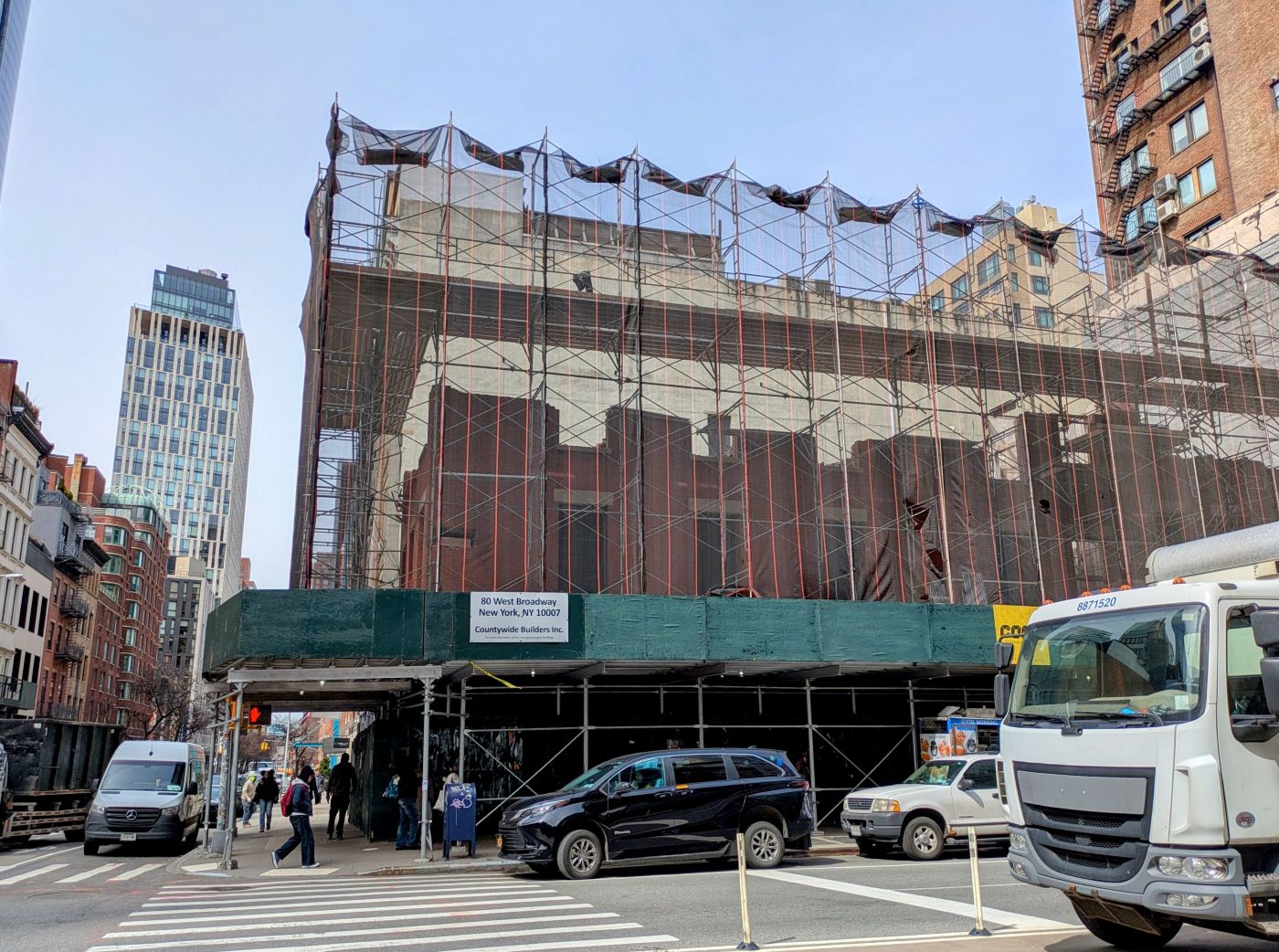
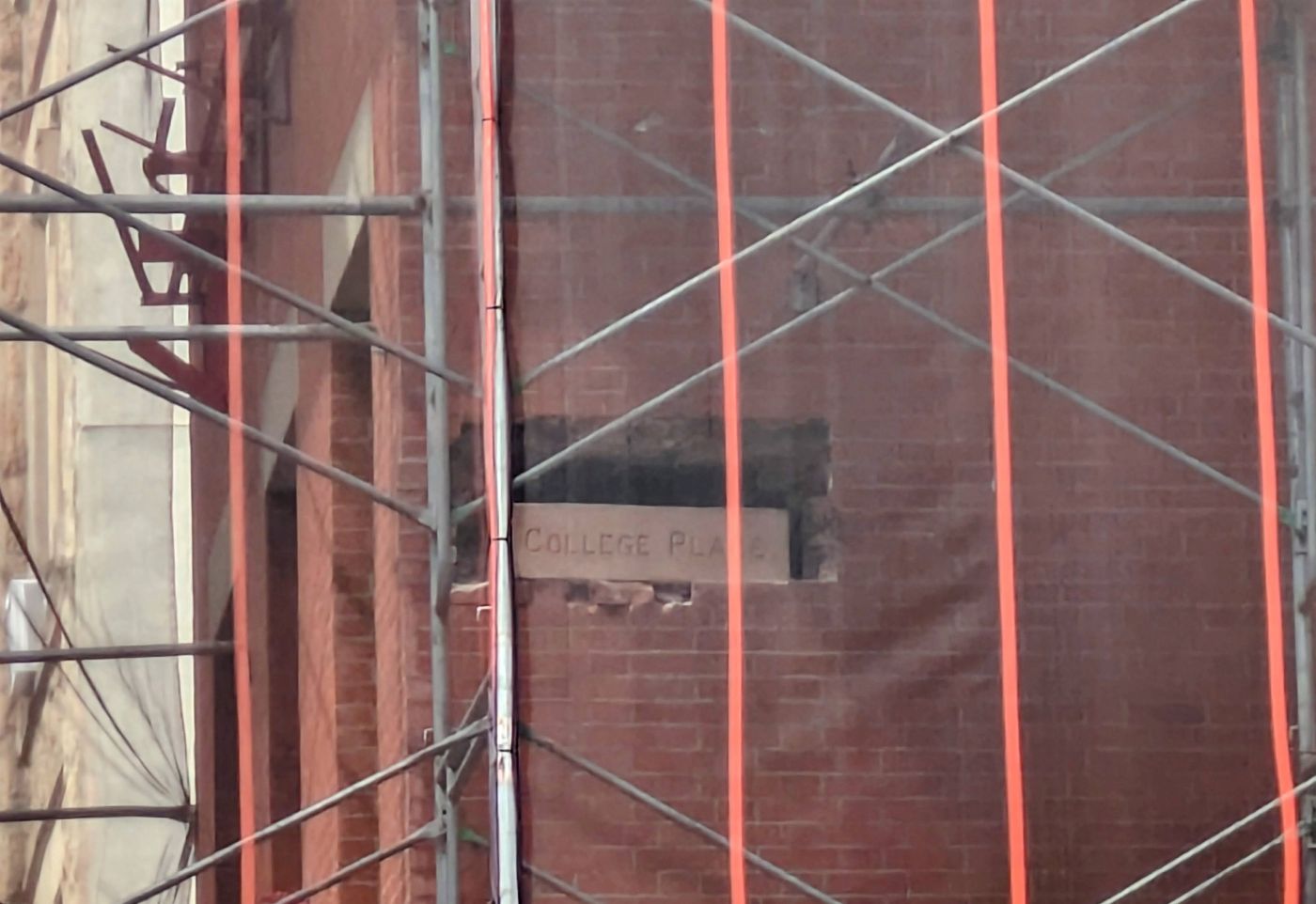
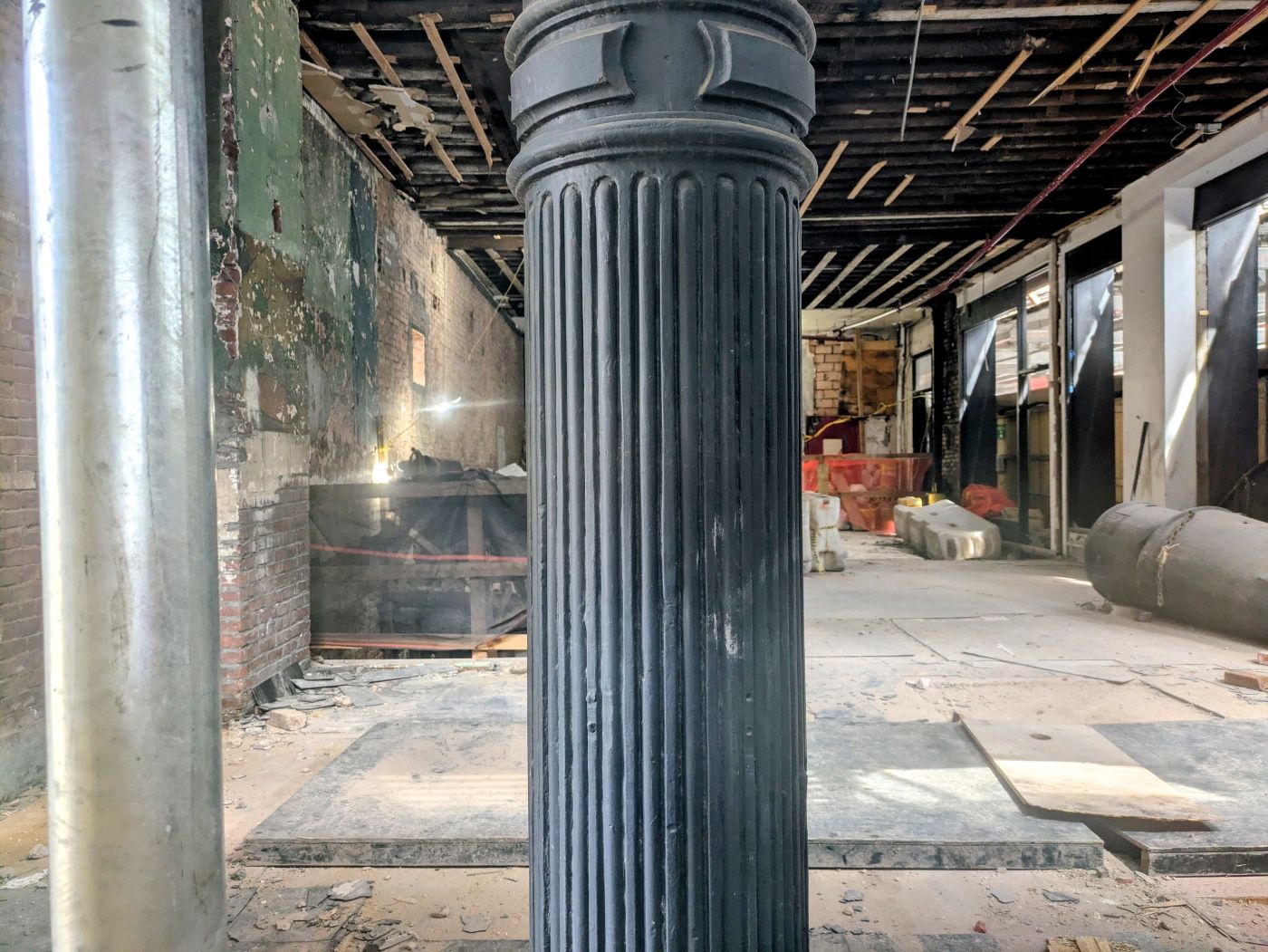
The five-story 19th Century brick building that is 80-86 West Broadway (northwest corner with Warren) is coming down now brick by brick, along with some neighborhood history — the vestigial remains of College Place.
I had hoped to have an update on the building that is to come from developer Astral Weeks, but in the meantime what’s left as of this week looked so much like the Acropolis through the construction netting that I had to share.
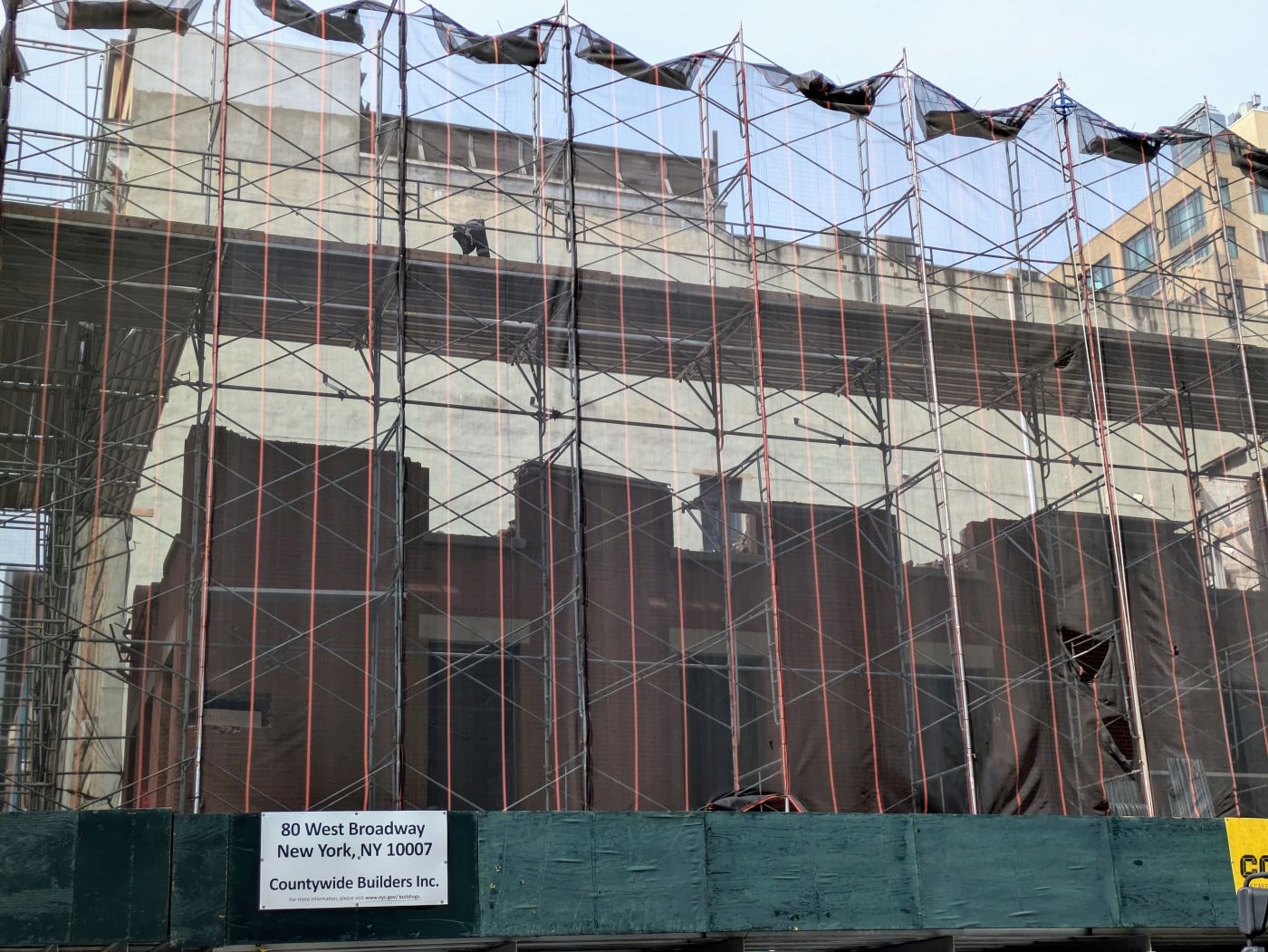
COOKFOX Architects has been engaged for the site, which will be 13 stories, 145 feet tall, mixed use residential and commercial. Demolition started in September.
The new building will go from the corner of Warren west to the parking lot and north to 88 West Broadway, which is the L-shaped building that is also 72 Warren.
7 Comments
Comment:
Medium rectangle #1 (top)

Right column rectangle ads


Mega rectangle

Restaurant guide icon

It would be cool if they could incorporate the “College Place” stone street marker in the facade of the new construction.
We’ve seen this before. They tear down a gorgeous old beauty from the 19th century. They leave a hole in the ground. That hole in the ground destabilizes neighboring structures. Someone sues. That hole in the ground becomes the new normal for a decade or two while they sue each other. Nothing happens. Meanwhile, the hotel that wants an extra floor or two on the roof (big effing deal…) so they can stay in business – no way. Then they tear down another 19th century beauty…and leave another hole in the ground. Somehow, this is supposed to make sense.
I share the deep sadness at seeing this building and others like it leave the neighborhood, but to be clear, the hotel that “wants an extra floor or two on the roof” DID destabilize the building next to it… and from what I saw in the CB meeting, still hasn’t made them whole on the damages. So yes, it IS a “big effing deal”
Is any of this being recycled/reused? I’ve peaked in and seen the size of those old floor beams. Makes my furniture making friends go starry-eyed dreaming of creative uses.
Surely not a great building architecturally but also surely invaluable as a ‘contextual’ one. All of Tribeca should have been landmarked, as the Village was, and as Hal Bromm tried so hard to have done. More glassy ‘luxury lofts’, what a shame.
I resided with my wife at 84 West Broadway for 42 years. My daughter resided with us till she went off to college. I loved my “loft” and enjoyed my neighbors. I moved into the fifth floor, 5N, and across the way was an artist who stretched canvas for Larry Rivers and did some painting and sculpture of his own under an open skylight. Below him was a guy who sold linoleum, and when he moved his business out, Buster Rhymes moved in for several years. Other artists and an architect lived in the building. We were a community. Those who lived on the top floors shared a freight elevator that sometimes worked and sometimes didn’t, and so neighbors helped my wife and me up with packages when the elevator was out. On street level were two and sometimes three stores. Very early their was an elderly tailor who you could leave your keys with or a basket on wheels for the laundry for the laundry mat and used to shop in Chinatown because there was only Morgans for one’s groceries. That tailor was replaced by a liquor store and finally a store that sold eyeglasses. Closer to Warren St was a series of coffee shops and a “kitchenette” that later moved to Chambers St. The building was run and owned by Mr. Jaffe, who was elderly and kind and kept the rents low. Today, my wife and I live next door and suffered as our wonderful building was knocked down. Soon , construction is scheduled to build another building next to us and on top of us. I don’t look forward to it.
South of Chambers Street:
In the late 1980s, our local community group pressed the Landmarks Commission (LPC) to create one large Tribeca HD, following Andrew Dolkart’s carefully considered boundary map. However, we soon learned disheartening news through an intriguing confidence shared between friends. LPC Chair David Todd and his wife were close with two members of our group, Oliver and Deborah Allen. At a dinner together with Mr and Mrs Todd, Oliver and his wife learned that then-Mayor Koch had told Chair Todd to NOT designate ANYTHING below Chambers Street. It seemed that Wall Street donors to the mayor imagined the area as a northern extension of the Financial District, complete with massive new towers featuring huge trading floors.
Working with the Tribeca Community Association and CB 1, our group had already documented the rich architectural history throughout the southern areas under the direction of Joan Olshansky, Marjorie Pearson et al at LPC. Learning that the many contributing buildings south of Chambers Street would be summarily excluded from any consideration at a public hearing was a serious blow, but at least there was research and photographic evidence of what should have been protected.
By the early 90s four (small) districts were designated, leaving out anything south of Chambers Street. Between them there was just enough room for a bulldozer to pass through.
There was then a new group formed with CB 1 member Roger Byrom: The Committee to Expand the Tribeca Historic Districts. We successfully lobbied LPC chairperson Sherida Paulsen to work with us to expand the district south of Chambers Street. The encouraging but meager result was that several buildings were included in the expansion from Chambers to Warren Streets. However, what Paulsen imagined as the beginning of a larger expansion effort never happened, as Ms. Paulsen was followed by Meenakshi Srinivasan as Chair of LPC.
In 2015, a report was prepared by Gregory Dietrich on behalf of the Tribeca Trust:
Tribeca Southeast and Southwest Extensions: A Proposal for Historic District Designation
It was submitted to LPC and summarily rejected by the LPC Chair Meenakshi Srinivasan, who stated the LPC was ‘done with Tribeca’.
Last year, HDC requested an expedited LPC Emergency Calendaring/Designation Request for
80 West Broadway and 72 Warren Street – Block 137, Lots 1, 3 (aka 7506) and 7 (aka 7507)
Tribeca, Manhattan Borough, New York
The response from LPC staff member Margaret Herman :
June 05, 2025
Frampton Tolbert
Executive Director, Historic Districts Council
231 West 29th Street, Ste. 707
New York, NY 10001
Re: Tribeca West Historic District Extension
Dear Mr. Tolbert:
Thank you for your recent Request for Evaluation of the Tribeca West Historic District Extension, consisting of buildings on
Warren Street, West Broadway, and Hudson Street.
LPC has previously surveyed this area of Tribeca multiple times since the 1980s and has never identified it for inclusion in a
historic district due to a lack of consistent historic character, integrity, and cohesion with nearby designated blocks. In
response to your request, we resurveyed the area, comparing each building’s current condition to its appearance in the
1940s tax photographs, and comparing the block to the Tribeca West Historic District to which it is proposed as an
extension. Research staff found that the requested buildings have been substantially altered from their original design,
including entrance and cornice modifications, a rooftop addition, a vacant lot, and storefront changes. Additionally, the
proposal’s location on only one side of the street along West Broadway detracts from the proposed area’s sense of place.
Based on the level of alterations and lack of cohesion, these buildings do not appear to rise to the level of a New York City
historic district extension. Staff also determined that 80 West Broadway, requested separately, does not possess on its own
the level of architectural quality and historic significance necessary for consideration as an individual landmark. Please
understand that in a city the size of New York, LPC must be very rigorous in determining significance and merit for
designation as a New York City landmark, especially when considering historic district extensions.
We thank you for your commitment to historic preservation and appreciate your interest in the work of the Landmarks
Preservation Commission.
Sincerely,
Margaret Herman
Margaret E. Herman, Ph.D.
Director of Research
253 Broadway, 11th Floor | New York, NY 10007
p: 212.602.6392 | mherman@lpc.nyc.gov
http://www.nyc.gov/landmarks
The reference by the LPC that they have “previously surveyed this area of Tribeca multiple times since the 1980s and has never identified it for inclusion in a historic district” does not acknowledge the failure to identify the area or include it in an historic district was due to the Koch administration pressure on LPC chairperson David Todd to not even consider the area or permit the merits of the area to be heard at a public hearing. While perhaps Ms. Herman is unaware that LPC was ordered to not designate anything south of Chambers Street, her response also fails to acknowledge that there were historic district extensions below Chambers Street in years following the original designations. This begs the question of how those extensions could have happened if, as she claims, there was a “lack of consistent historic character, integrity, and cohesion with nearby designated blocks”?
The statement that there are cornice modifications is sadly false. Further, the referenced ‘alterations’ are largely reversible: enclosed cast-iron columns, storefronts, etc.
While architectural historians differ with Ms. Herman’s view that there is a “lack of consistent historic character, integrity, and cohesion with nearby designated blocks”, it is ironic that LPC would pose such an argument, since the loss of historic fabric from 1988-2025 is due to the original failure of LPC to designate the area south of Chambers Street.
A comment from Gregory Dietrich is on point:
There does appear to be a self-created hardship on the part of LPC here; namely, that the agency could designate the buildings if they possessed the requisite integrity but they do not possess the requisite integrity because the agency has refused to designate them.
The original proposed historic district boundaries, as identified on Andrew Dolkart’s mapping circa 1986, were based on the architectural similarities in style, period, materials and, in many cases, architects, that were clearly identified in buildings both north and south of Chambers Street. The Chambers Street demarcation does not represent anything more than a line of pure political interference in the work of the Landmarks Commission, a practice that sadly has grown worse over time.
While the continuing failure of the LPC to uphold the NYC Landmarks Law is painfully obvious, what is also clear is the dilemma caused by LPC’s original failure to designate areas in new historic districts that merit inclusion.
Today the Tribeca community is shocked and saddened by the cumulative losses, most recently at College Place. Alas, the LPC failure to uphold the Landmarks Law to identify, preserve and protect the city’s historic landmarks and neighborhoods from alterations or demolition is nothing new; it dates to the 1980s.
Hal Bromm