
Left rectangle ads redesigned

History of Tribeca Buildings

The Fall Evaluation of Her Summer Body
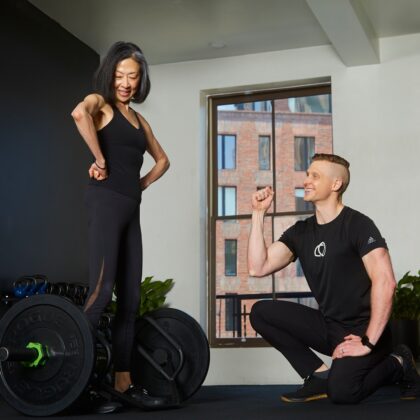
She did not stop moving all summer. Tennis twice a week, the Hudson River path most mornings, a long weekend of hiking upstate, two weeks abroad with a great deal of walking. An active person having an active season.
But, somewhere in August she noticed that her results stopped matching her effort. Tennis took longer to recover from, occasional aches and pains became daily hinderances, and it was harder to summon the usual energy for summer excursions.
At the end of summer, it is worth asking how the body held up? Did we look, feel, and perform our best or does it feel like we had to hold back? And is this simply how it goes now?
Not necessarily. At NYLO Fitness, at the corner of Church and White, many of our clients have gotten into the best shape of their lives in their forties, fifties, and beyond. Not the best shape for their age. The best shape they have ever been in. If you are not looking, feeling, or performing the way you want to, building strength and muscle is very often the answer, and September, not January, is when the work begins.
Apply for personal training at NYLO Fitness.
It Used to Be an Accident. Now It Is a Choice.
In our twenties, most of us looked good and performed well by default. Nobody had to decide to have a functioning back. That changes, and the body begins requiring that results be chosen, deliberately and more or less daily.
Which is why so many women who have never stopped working hard find their workouts no longer do what they once did. The effort is not the problem. The specificity is. Hard, unstructured training produces fatigue; structured training produces adaptation/results.
At NYLO that structure is progressive overload, applied rigorously. We track the quality of a movement, the load, the speed, and the repetitions, and we progress in at least one of them from session to session. Not every session is heavier. But every session moves.

The Rules Change, and Nobody Hands You the New Ones
Somewhere in the forties, the inputs stop producing the outputs they used to. The same food, the same activity, the same discipline, and a different result. It is disorienting precisely because nothing about the effort changed.
What changed is the hormonal environment. Through perimenopause and menopause, declining estrogen influences lean tissue, body composition, bone turnover, sleep, recovery, and how much energy a given day seems to contain. This is not a pathology and we decline to treat it as one. It is an ordinary part of a long life.
But it explains why a strategy that worked for two decades stops working, and it clarifies where the leverage now sits. When several variables are shifting on their own schedule, strength is among the few that answer directly to you. The muscle you’ll need in 20 years is far easier to protect now than to rebuild then.
Every NYLO program begins with a complete assessment.
Not Bigger. More Defined.
Most of our clients understand what muscle would do for them and hesitate anyway, because they do not want to get bulkier. It is the most common reason women stay out of the weight room, and it deserves a real answer.
The short version: the physiology that produces dramatic gains in size is not, for the most part, the physiology women are working with. Substantial mass is difficult and deliberate, and does not happen from two or three well-programmed sessions a week.
What happens instead is recomposition. Think of the historic buildings we love in this neighborhood, many of which have held the same footprint for a century while the interiors were transformed completely. Take the arm: the aim is not to change its size or circumference, but to bring the muscle closer to the skin so that muscle definition becomes visible. Definition is not a question of size. It is a question of distance.
Muscle does quiet work elsewhere as well. It is the body’s largest destination for glucose, so more muscle means that calories have somewhere productive to go rather than being stored as fat, making recomposition easier.
Reduce fat while building muscle and you do not get bigger. You get defined. We are not building muscle in spite of aesthetics. The muscle is the aesthetic. “Toned,” a word that women have been handed for forty years without anyone explaining it, has always meant muscle tone.
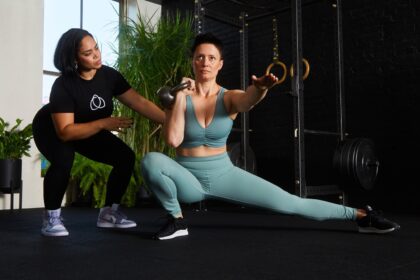
Bone Is the Part You Cannot See Coming
This is the section with the longest consequences. Women are more at risk for osteoporosis than men, and bone loss accelerates through the menopausal transition, often years before anything shows up on a scan. Unlike muscle, which announces itself in the mirror, bone gives almost no feedback until something breaks.
The encouraging part is that bone is living tissue, and it remodels in response to meaningful mechanical loading. Progressively loaded squats, hinges, carries, presses, and pulls deliver a skeletal signal that low-load activity, however diligent, does not send. Yoga and walking are good for a great many things. They are not enough to tell the skeleton to invest in itself.
The answer is not reckless heavy lifting. It is appropriately challenging loading, progressed intelligently and coached with attention.
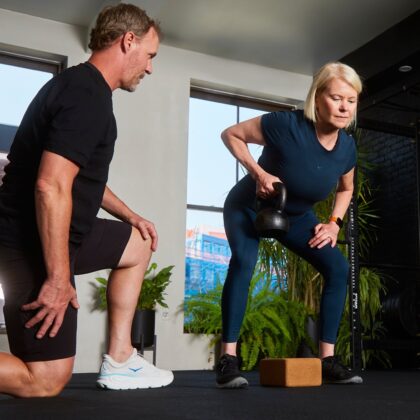
Reserve Capacity
Strength is not the point. What strength allows is the point.
A heavy roller bag up the subway stairs without waiting for someone to offer. A sleeping child carried up three flights. A parent steadied at the curb. A full day in Florence on cobblestones, and balance recovered when the footing goes wrong. A fourteen-hour travel day that does not cost you the following one to recover.
What strength builds is reserve, and daily life gets easier when ordinary tasks represent a smaller percentage of your maximum capacity. That margin is what makes a body feel young, far more than any number on a scale. It sits underneath everything our clients do for pleasure: tennis, golf, pickleball, cycling, hiking, ski weekends, long stretches of active travel. Stronger legs make a ski day cost less the next morning. Trunk and upper-body strength support the serve and the swing. The point is to keep all of it available.
What This Actually Looks Like
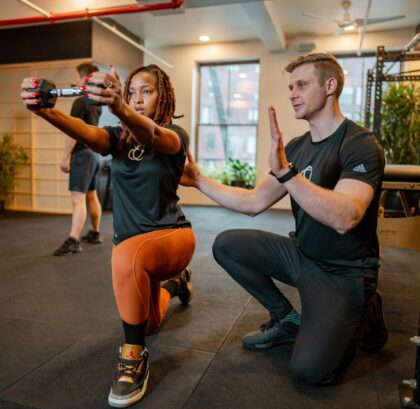
At NYLO, training programs prioritize fundamental movement patterns: squat, hinge, lunge, push, pull, carry, and trunk stability. These movements, performed consistently week to week, are progressed to increase strength, build muscle, and create the body that can withstand the demands of summer and beyond.
Every NYLO program begins with a detailed assessment of strength, mobility, balance, cardiovascular health, and work capacity. When building a program, we consider prior injuries, bone density concerns, changes in recovery through perimenopause, pregnancy history, and activity levels.
Train Now for the Summer You Want Next Year
Come to NYLO, where looking excellent turns out to be a side effect of being strong, capable, well-conditioned, and genuinely good at moving through the world.
You may have another forty or fifty active summers ahead of you. The goal was never to slow a decline. It is to keep the world large: travel, sport, work, family, spontaneity. And to arrive at next September with an entirely different question.
………………………….
Sponsored by NYLO Fitness
Medium rectangle #1 (top)

Right column rectangle ads



Restaurant guide icon