


Left rectangle ads redesigned

History of Tribeca Buildings
Corner site at Franklin and Varick has sold

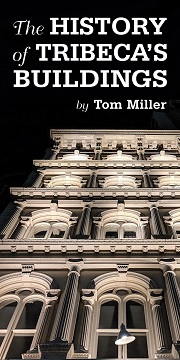
The prominent and handsome Sofia Brothers storage building on the southwest corner of Varick and Franklin has been acquired by Broad Street Development, according to PR Newswire, which has plans is to develop a boutique, luxury residential condominium within the original building envelope. The Commercial Observer reported that they paid $44 million for the building, which last changed hands in 1967.
Built in 1909 as a warehouse, the 10-story, cast iron, brick and stone building sits squarely in the Tribeca West Historic District. It has 13-foot ceilings and is 53-feet wide.
(The building next door, 143 Franklin, also just sold.)
The firm has also converted the residential properties 40 Bleeker and 215 Sullivan in the Village and redeveloped office properties such as 80 Broad and 55 and 61 Broadway. The press release said that 139 Franklin will be the first in a series of new residential properties the company will redevelop under the Broad Street Bespoke brand.
Here are some more details from the historic district designation report:
Designed by the well-known firm of Maynicke & Franke for the Strohmeyer & Arpe Company, an importing business founded in 1882, it was erected in 1909. Previously on the site stood a two-and-a-half-story Gothic Revival structure which had been the home of the Fourth Associated Reformed Church during the 1850s. That structure received a five-story brick rear addition for a “factory and workshop” in 1873, built by Havilah M. Smith for Taylor & Wilson; by 1887 Beach & Sherwood, produce and grocery merchants, occupied the addition and at some point converted the former church building to commercial use.
Maynicke & Franke’s design, articulated with a cellular treatment typical of early-twentieth-century commercial buildings, is embellished with neo-Renaissance elements. The six-bay facade, which by conforming to the irregular street configuration has a chamfered eastern bay, is composed of a two-story base and an eight-story upper section. Faced in coursed stone, the base retains its segmentally-arched entranceway of polished-stone Tuscan columns and an entablature, containing paired wood doors and a transom. In front of the entrance there is paving of concrete with glass lens. To the west, cast-iron piers and a pressed-metal cornice survive, framing the historic wood infill of the five loading bays. A loading platform and metal awning with skylights extend across these five bays.
At the second story, the coursed stone separates simple rectangular window openings and supports a stone cornice. Giant piers span the brick-faced upper section of the building, broken only by a cornice above the eighth story. Window openings mostly have flat stone lintels, although some have segmental brick arches; two-over-two wood sash windows survive. Spandrels are of unadorned brick except below the third story’s end bays and below the top story, where they support a geometric pattern. The parapet is characterized by corbelled brick and is raised at the end bays. The exposed side elevations are parged brick walls with many historic multipane windows.
In 1920-21 a rear bridge was built to connect this building to No. 27 Leonard Street.
4 Comments
Comment:
Medium rectangle #1 (top)

Right column rectangle ads


Restaurant guide icon


This building most hold the neighborhood record for longest continuous scaffolding, at least 20 years.
It’s not going to be pleasant living at 137 Franklin, where the penthouse sold for $10 million in 2021.
Just what the neighborhood needs, along with 1 Walker St. — more “luxury” apartments.
why the F was this place allowed to keep scaffolding up for the last 10+ years and now it will turn into a massive construction site. The city really needs to do something about this scaffolding problem. Absolute disaster.