


Left rectangle ads redesigned



History of Tribeca Buildings
City moving forward with development of 100 Gold
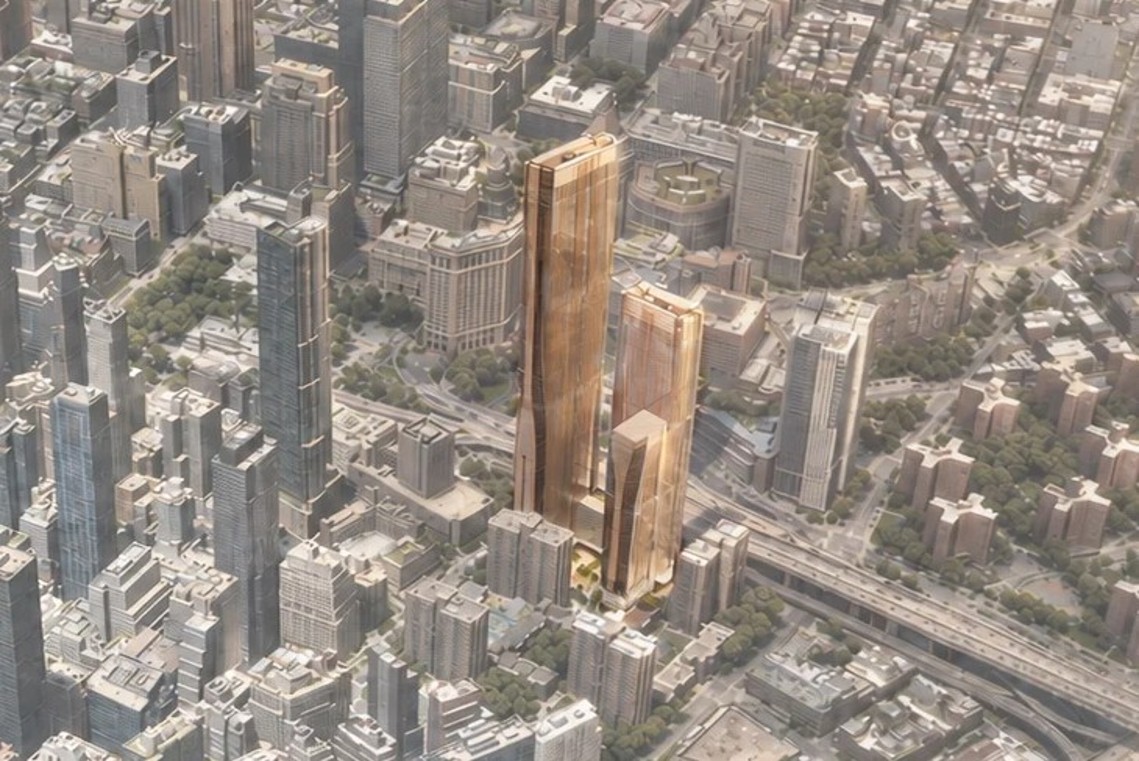
Rendering: CetraRuddy Architects
The city is moving forward with a plan first put in motion during the Adams administration to develop 100 Gold, a squat, city-owned building tucked just south of the Brooklyn Bridge, into a skyscraper with 4000 new residential units. The public review process starts today and will include meetings at Community Board 1, which has pushed back against the plan since it was first proposed in February 2025.

The developer is GFP Real Estate, which owns 220 Church (where Frenchette Bakery is; Roger Gural, who founded Arcade Bakery, is a son of Jeffrey Gural, the chairman of GFP), 71 Thomas and the retail at 416 Washington, and is also developing 25 Water — the largest conversion in the country — and several other buildings in the Financial District.
But the new proposal is for a larger building with 300 units and also includes:
- around 1,000 permanently affordable, rent-stabilized homes (25 percent of the total)
- 40,000 square feet of new public open space as well as a new state-of-the-art, publicly-accessible fitness center inside the building
- an upgraded older adult center for the community.
Proceeds from the sale will be partly used to relocate the city agencies currently operating at 100 Gold.
The building is tucked into the northwest corner of the Southbridge Towers site, with Frankfort on the north and a vestigial Spruce Street running around the east and west sides. It was constructed in the 1960s and currently houses 500,000 square feet of city agency offices.
Originally announced in Adams’ 2025 State of the City address, the 100 Gold project will take advantage of “City of Yes for Housing Opportunity” density allowances. The project should certify into the Uniform Land Use Review Procedure (ULURP) in 2027, when more public review sessions through Community Board 1 and the City Council will start.
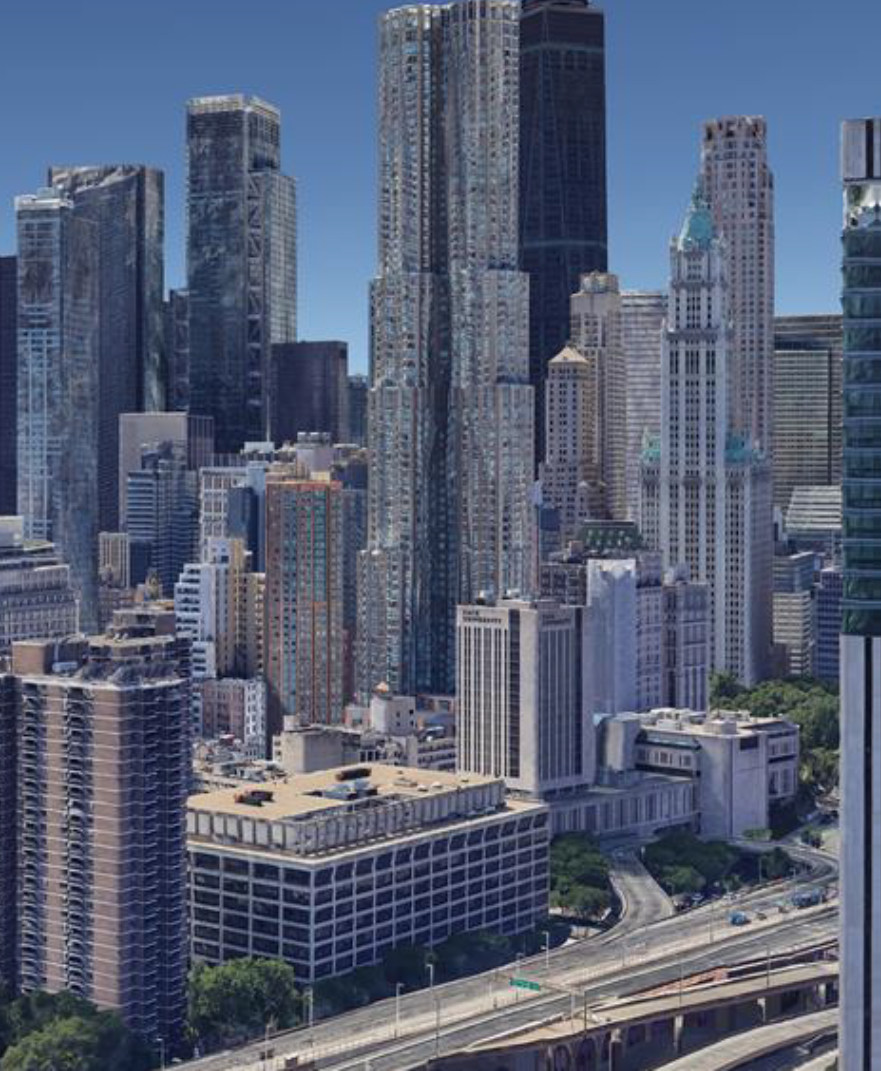
Photo: NYCEDC
12 Comments
Comment:
Medium rectangle #1 (top)

Right column rectangle ads


Mega rectangle

Restaurant guide icon


Yes housing is needed.
But reminder – the narrow 2/3 platform at Fulton Street is already too crowded and a disaster waiting to happen.
There is no way to fit more people on that platform.
I do wonder about all of the new residences going into FiDi given there is virtually no green space, very narrow roads already burdened, narrow sidewalks and already feels overpopulated for these and other reasons. Is this being explored at all?
FIDI is ringed along the coastline by terrific green space; has green pockets like Bowling Green, the Elevated Acre, City Hall Park; open spaces like Broad Street and the Seaport; and playgrounds at the Seaport and the Battery. The transition from moribund office buildings to vibrant residential buildings is most welcome. And, thanks to congestion pricing, the traffic has abated!
Before 2010, the area was still mostly office (personally I would not describe as moribund) and actually less traffic.
There were numerous streets without traffic lights nor need for them.
The Gehry building went up – then many more luxury high-rises, new hotels, Pace expansion. Also many more chain food places,
All of these have generated much more traffic – Uber, Amazon, building services, construction.
Fulton, John, William,Nassau, Beekman etc are often congested. BTW that has serious impact on folks needing to get to the hospital, medical offices, social security.
The luxury high-rise residential buildings have also resulted in massive amounts of trash.
Relative to other parts of the city FiDi has comparatively little green space, let alone trees on the streets. Further, my comment included issues other than lack of open space: narrow sidewalks, narrow subway platforms, narrow streets, all meant to accommodate pedestrians in the 17th century.
One solution to the lack of common areas and too much traffic: close streets to cars/trucks permanently, and convert them into pedestrian spaces, courtyards, etc.
Ben
If the area was pedestrianized, what would happen with emergency vehicles, Access a Ride, school buses, trash pick-up?
The hospital? The fire station on Beekman? Special ed school on John? Post office on John? ACS on William? Social Security on William? Federal Reserve on Maiden Lane?
Amazon, delivery for restaurants & stores, service & repair vehicles, movers and so on?
Right now, delivery workers are already hauling heavy stuff for blocks because there is no place to park and unload.
IMO not a good look that people in expensive housing get to stay home and order stuff – and the workers need to struggle to deliver their stuff.
If residents would stop ordering Amazon, there’d be a reduction in vehicles :)
For what it is worth I don’t drive and don’t use Uber, but IMO the increase in traffic is clearly the result of overdevelopment of residential and hotels on old narrow streets.
My concern is not any one building in isolation—it is the cumulative impact of (100 Gold St, 250 Water St, 58 Cliff Street) all massive developments surrounding Southbridge Towers at the same time.
What is the City’s coordinated plan for years of construction noise, dust, truck traffic, street closures and environmental impacts? And once these projects are complete, where is the corresponding investment in supermarkets, schools, sanitation, emergency services and other basic neighborhood infrastructure? Adding thousands of residents without a clear plan for how the neighborhood will function is not responsible planning.
Exactly. You stated this better than I did.
I pass by 100 Gold a couple of time a week. At street level it seems dank and squat, and could obviously be put to better use. But four thousand new apartments added to the northernmost Southbridge Towers superblock? Can one have too many neighbors?
Even though more housing is needed, it seems that we’re heading back to the ultra-high-density designs that doomed some Federal housing developments decades ago.
What happens if the former parking lot across from Southbridge is also developed? There was such a furor from the area when that seemed inevitable; one day, building on the site of that Hughes Corporation lot would only add to the burden on municipal services, retail, etc., caused by the conversion of nearby office space into housing.
The developer, and our city leaders, should consider not building “as of right,” but “within reason.” Think and plan a bit better now – the neighborhood will have to live with the result for many years to come.
A lot of NIMBYism in these comments. Financial district is basically the birthplace of the skyscraper, has always been crowded, but somehow trading residents for office workers is so much worse? Sure, maybe the area’s under schooled (I bet there’s some vacant office space that can solve that) but otherwise it seems to me an excellent place to add more affordable housing.
Throwing the word NIMBY into the mix suggest you did engage the reasonable concerns expressed here. Worse than NIMBYism is the after the fact OOPS we have all experienced when living with blinkered city planning.