

Left rectangle ads redesigned
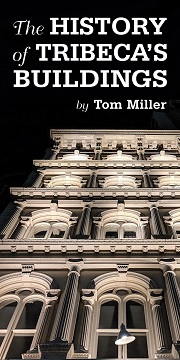
History of Tribeca Buildings
In the News: Keith Haring mural is for sale with its apartment
The Times has a story on the Keith Haring mural that is embedded in a ground-floor apartment in the American Thread building. It was discovered two owners back, in 2007. It’s above in the WSJ’s Mansion Global video tour of the apartment in 2021.
Haring had to paint it in 1979; he had just arrived in the city that year and enrolled at the School of Visual Arts. The school reportedly had a student exhibition hall on the ground floor. The building was converted a year later.
New York magazine covered the uncovering back in 2008; the renovation of the space had taken six years in part because the owner who purchased the unit in 2001 — and when the mural was first discovered — died in the World Trade Center attacks. His widow sold it in 2006 and the apartment changed hands a couple times after that — in 2015 and again in 2018. And the mural survived.
From New York magazine: “The architects Todd Ernst and Frank Servidio knew that the spot in which Ernst was building a maisonette might also contain a treasure…As soon as they got the job in 2001, the architects began to search, and it didn’t take long to confirm the rumor. ‘It was like discovering an Egyptian tomb,’ says Ernst. Within a week, they’d found a wall of those famous chunky curlicues, hidden behind a closet used for coats and AV gear. ‘The fact that it actually survived is amazing,’ says Ernst. ‘It’s next to a sprinkler pipe and it’s made of shoe polish and alcohol, and it’s water soluble.'”
The 8000-square-foot space is now listed for $23 million. If I am reading the records correctly, the full sale price in 2022, when the current owner bought it, was $6.5 million. It was listed the previous year for $7.9 million.
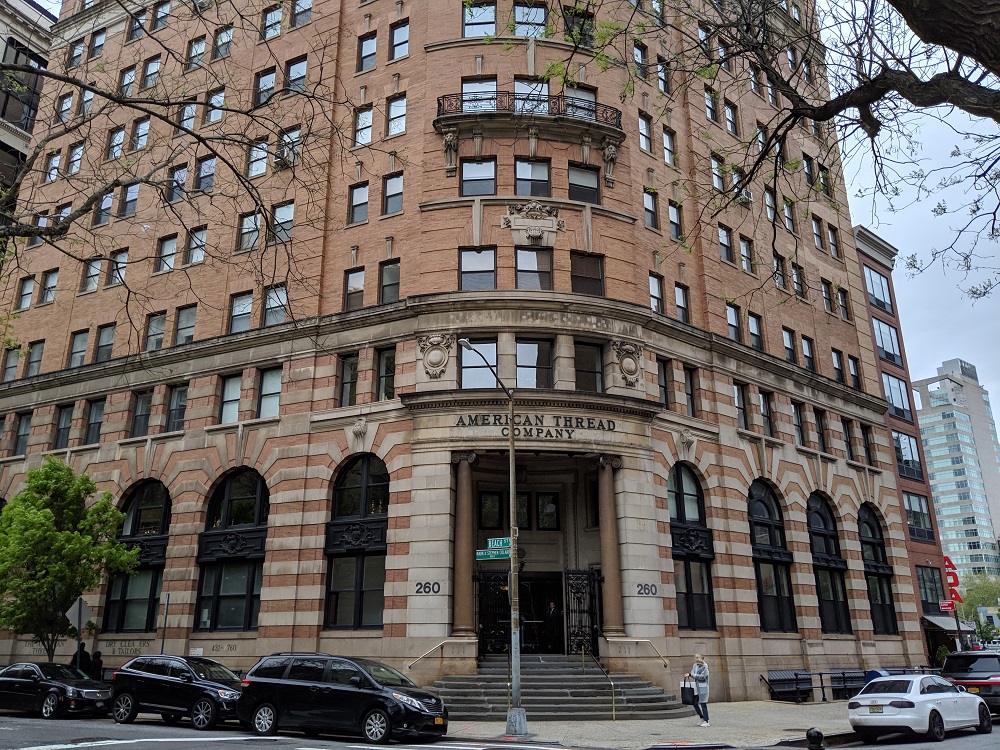
You can read the most excellent history of the building — starting in 1890 — from Tom Miller’s post; here is the more recent story of 260 West Broadway:
In 1965 the American Thread Company moved to 90 Park Avenue. It was a marked change for the former Wool Exchange Building. Department of Buildings records listed a paint store in the former bank space, a lamp showroom on the second floor, and “third and fourth to be kept vacant.”
Other tenants then included the Kikkoman soy sauce company; Albert Products, Inc., distributors of Wool-Soft fabric cleaner; and by 1970 the offices of the Archaeological Institute of America.
The institute published the American Journal of Archaeology and Archaeology, A Magazine Dealing with the Antiquity of the World here. The group also sponsored exotic tours. In the spring of 1971 it offered a 32-day tour of cave paintings in France and in April 1974 a three-week visit to Iran and Afghanistan.
On August 25, 1977, Laurie Johnston, writing in The New York Times, remarked that the neighborhood was taking on a Soho-like personality. Advising that “Tribeca” was “the unofficial name for the Triangle Below Canal Street (pronounced Try-beeka by logic, Try-becka by custom),” and mentioning high-profile figures in the arts who had recently moved in, she added that the American Thread Building was “among other major Tribeca Buildings being prepared for conversion” to residential.
The renovation, which was completed in 1981, prompted The Times’ Paul Goldberger to call the project “probably TriBeCa’s finest and most luxurious condominium conversion so far. It is a more elegant building that many of its neighbors, graciously rounding the curve of the street as West Broadway meets Beach Street.”
An advertisement in Christopher Magazine in 1982 touted, “There is nothing standard about 260 West Broadway.” Indeed, several of the apartments were duplexes.
The upscale building received disturbing press in July 1993. In 1987 Louis Santos had been hired as a custodian. Well liked by the residents, he arrived for work as usual at 7:00 on the morning of July 17, 1993 but never reported in. At 9:20 sanitation workers pulled up to the loading dock at the rear of the building, where they found the 50-year-old’s body, with two bullet wounds to the head. His empty wallet was on the ground next to him.
Comment:
Medium rectangle #1 (top)
Right column rectangle ads


Mega rectangle

Restaurant guide icon